<?xml version="1.0" encoding="utf-8"?>
<feed version="0.3" xmlns="http://purl.org/atom/ns#" xmlns:dc="http://purl.org/dc/elements/1.1/" xml:lang="en">
  <title>Dan Washburn&apos;s Sporting Life</title>
  <link rel="alternate" type="text/html" href="http://www.danwashburn.com/mt/sportinglife/" />
  <modified>2006-06-14T02:31:40Z</modified>
  <tagline>A complete archive of Dan&apos;s award winning columns written for The Times in Gainesville, Georgia, from 1998-2002. Join Dan as he tries bull riding, sky diving, ice climbing, &quot;handgrabbing&quot; for giant catfish and much, much more. (This blog is currently under construction. For more Sporting Life columns, go here.)</tagline>
  <id>tag:www.danwashburn.com,2008:/mt/sportinglife/4</id>
  <generator url="http://www.movabletype.org/" version="3.33">Movable Type</generator>
  <copyright>Copyright (c) 2004, Dan Washburn</copyright>
  <entry>
    <title>Be patient, please</title>
    <link rel="alternate" type="text/html" href="http://www.danwashburn.com/mt/sportinglife/archives/000423.html" />
    <modified>2006-06-14T02:31:40Z</modified>
    <issued>2004-06-12T14:33:51+08:00</issued>
    <id>tag:www.danwashburn.com,2004:/mt/sportinglife/4.423</id>
    <created>2004-06-12T06:33:51Z</created>
    <summary type="text/plain">New entries are being added from the archives every day....</summary>
    <author>
      <name>Dan Washburn</name>
      <url>http://www.danwashburn.com</url>
      <email>dan@danwashburn.com</email>
    </author>
    
    <content type="text/html" mode="escaped" xml:lang="en" xml:base="http://www.danwashburn.com/mt/sportinglife/">
      <![CDATA[<p>New entries are being added from the archives every day.</p>]]>
      
    </content>
  </entry>
  <entry>
    <title>It&apos;s always hard to say goodbye</title>
    <link rel="alternate" type="text/html" href="http://www.danwashburn.com/mt/sportinglife/archives/000374.html" />
    <modified>2006-06-14T02:31:38Z</modified>
    <issued>2002-07-25T18:02:16+08:00</issued>
    <id>tag:www.danwashburn.com,2002:/mt/sportinglife/4.374</id>
    <created>2002-07-25T10:02:16Z</created>
    <summary type="text/plain">(It&apos;s even harder when you have to say it in Chinese) Well, I don&apos;t have the plague. Not yellow fever, psychosis or leprosy, either. How do I know this, you ask? Did I feel a case of the plague coming on and run off to the doctor? &quot;Hey, Doc. I think I&apos;m coming down with some of that, uh, plague that&apos;s going around. Got any Robitussin?&quot; No, nothing like that. It&apos;s just that there are certain diseases -- plague among them -- that you must be tested for before moving to China. And I&apos;m moving to China....</summary>
    <author>
      <name>Dan Washburn</name>
      <url>http://www.danwashburn.com</url>
      <email>dan@danwashburn.com</email>
    </author>
    <dc:subject>Other</dc:subject>
    <content type="text/html" mode="escaped" xml:lang="en" xml:base="http://www.danwashburn.com/mt/sportinglife/">
      <![CDATA[<p><i><b>(It's even harder when you have to say it in Chinese)</i></b></p>

<p><a href="http://www.danwashburn.com/mt/sportinglife/archives/goodbye1.html" onclick="window.open('http://www.danwashburn.com/mt/sportinglife/archives/goodbye1.html','popup','width=500,height=534,scrollbars=no,resizable=no,toolbar=no,directories=no,location=no,menubar=no,status=no,left=0,top=0'); return false"><img src="http://www.danwashburn.com/mt/sportinglife/archives/goodbye-thumb.jpg" width="250" height="267" border="0" align="right" /></a>Well, I don't have the plague.</p>

<p>Not yellow fever, psychosis or leprosy, either.</p>

<p>How do I know this, you ask? Did I feel a case of the plague coming on and run off to the doctor?</p>

<p>"Hey, Doc. I think I'm coming down with some of that, uh, plague that's going around. Got any Robitussin?"</p>

<p>No, nothing like that. It's just that there are certain diseases -- plague among them -- that you must be tested for before moving to China. And I'm moving to China.</p>]]>
      <![CDATA[<p>Seriously. Cross my heart. Pinky shake. Booga booga. This is for real.</p>

<p>My year-long gig as an English professor at Shanghai University starts Sept. 1. My flight leaves in 35 days.</p>

<p>Thirty-five days! I better write quickly. I've got a lot of packing to do.</p>

<p>My last day at The Times is Saturday. This is the last Sporting Life column I will write for a while.</p>

<p>Now, I know what you're thinking: Dan, you're crazy. But, c'mon. Admit it. You've thought that before.</p>

<p>You've likely got two questions for me. Everybody else has.</p>

<p><b>1. Do you speak Chinese?</b></p>

<p><i>My answer is always a quick, "Yes." But then I laugh and admit that I'm lying. Seems my future employers were interested in my grasp of my own language, not theirs.</p>

<p>Native English speakers are a hot commodity over there. Shanghai is a city of more than 15 million -- and less than 1 percent of the population speaks English. Yikes!</p>

<p>But that's nothing new for me. I didn't understand half of what y'all said when I moved down here almost four years ago.</p>

<p>Just kidding.</p>

<p>Kind of.</i></p>

<p><b>2. Dan, are you a spy?</b></p>

<p><i>Well, duh. Obviously. Why else would I spend one-seventh of my life in the Chicken City. Poultry world, you have a new capital. Its name is Shanghai.</p>

<p>But seriously, I do plan on doing some spying while in China. However, I will spy on no one important, no one in particular. I will choose people at random and follow them. I will jot down notes on a yellow legal pad and take photos with my new digital camera.</p>

<p>I will send my findings via carrier pigeon to Back Porch columnist Jim Chapman, who seems like he'd be into such nonsensical espionage.</p>

<p>(Mental note: Try to keep fake talk of spying to a minimum before moving to communist country.)</i></p>

<p>Perhaps the most difficult question is also the most simple. Why?</p>

<p>"Why not?" is what I usually say to that. It's purposefully vague and has a certain gung-ho-I'll-try-anything-as-long-as-it's-not-bull-riding-again spirit that fits perfectly with the concept of this column.</p>

<p>Truth is, I'm not sure why I'm moving to China. Truth is, if three months ago you had told me that I was going to be moving to China, I would have looked at you as if you were dying of the plague.</p>

<p>I wish I could cite some higher calling, some deep and burning desire to teach the people of the world the joys of the English language, or even a longstanding longing to learn about everything and anything non-Western.</p>

<p>Nope. I was just trying to figure out how I could get my summers off. Really.</p>

<p>This plan -- both silly and shallow, I know -- was hatched innocently in Honolulu in late May. I was there for my brother's wedding, lying on the beach during the last day of my 10-day vacation. And I didn't want to leave.</p>

<p>I daydreamed about Natalie Portman and more days off. I determined that Natalie Portman was probably unattainable, so I concentrated on the days off.</p>

<p>"That's it!," I thought, "I'll become a teacher."</p>

<p>(Now, teachers, please don't get mad and send hate mail. I know that teaching is really a year-round job. I know that most teachers need to get a second job during the summer, anyway. I know that 35 days from now, I will likely be in way over my head. Please understand that this was just a daydream ... and that I was likely still feeling the ill effects of a poorly-prepared batch of poi.)</p>

<p>I thought about going back to school. But then I stopped thinking about that, because I never much cared for going to school -- the actual schoolwork part of it, anyway.</p>

<p>Then I remembered hearing that some teaching jobs abroad require nothing more than a bachelor's degree and a willingness to travel. I was qualified.</p>

<p>I mentioned the daydream to my dad, a college professor. He mentioned that he had some connections in Shanghai. Ba-da-bing-ba-da-boom, I'm headed to China.</p>

<p>Of course, I'm now realizing, it's not that simple. I need to sell off most of my possessions (if you're interested in any furniture or appliances, drop me a line). And I need to get stuck with so many needles even Scott Weiland would cringe. Gotta stave off that nasty Japanese Encephalitis bug, you know.</p>

<p>But with every unexpected step in the moving process, with every goodbye that crosses my lips, I realize -- more each day -- that there is much I will miss about this town I've called home since the fall of 1998. (I was never able to refer to Gainesville as a "city.")</p>

<p>I suppose I always figured I was just passing through, though. I kept the Pennsylvania plates on my car. But one year quickly turned into two ... then three ... now four.</p>

<p>Other than the town I grew up in, I've never lived anywhere longer than Gainesville. And it's grown on me. I'm a small-town boy at heart. I like the fact that I can walk into a grocery store, a bar, a barbecue joint and be referred to by name.</p>

<p>So, naturally, I now choose to live in the most populous city in the world's most populous country -- where most people won't be able to pronounce my name, let alone remember it.</p>

<p>This column was originally going to be a list of things I would miss about Gainesville, but the list got too long. And I got hungry.</p>

<p>I jotted down items like "seeing the mountains while driving north on Pearl Nix Parkway on a clear day." But then it turned into a roll call of my favorite local foods (Monkey Barrel pizza, Hickory Pig barbecue, Los Rayos quesadillas, etc.). I had to break for lunch and get some Brunswick stew.</p>

<p>I did more than eat here, of course. I tried to do a little living, as well. Items not on my resume before I moved here: bull riding, lawnmower racing and handgrabbing for giant catfish in Mississippi, to name a few.</p>

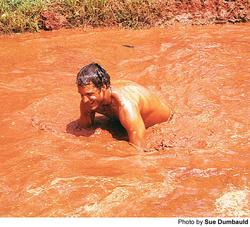
<p>I found it fitting, in an odd way, that my swan song was a swan dive into a pit of mud at the Redneck Games. Quite a Southern sendoff.</p>

<p>So now it's on to the next column, er, chapter of my life. It comes with subtitles, and I have no idea how it ends.</p>

<p>Just the way I like it.</p>

<p>(By the way, I'm off next summer. Anyone want to backpack to Tibet?)</p>]]>
    </content>
  </entry>
  <entry>
    <title>Redneck Games: You might be a redneck ... if you enjoy this column</title>
    <link rel="alternate" type="text/html" href="http://www.danwashburn.com/mt/sportinglife/archives/000377.html" />
    <modified>2006-06-14T02:31:38Z</modified>
    <issued>2002-07-18T18:36:36+08:00</issued>
    <id>tag:www.danwashburn.com,2002:/mt/sportinglife/4.377</id>
    <created>2002-07-18T10:36:36Z</created>
    <summary type="text/plain">When I stepped out of my air-conditioned car, the heat hit me like a right hook. The sun was searing and inescapable. Everything, everyone seemed to be surrounded by an abstract haze, kind of like the watercolor paintings that rise from hot highways in the summertime. I was standing in a crowded parking lot in East Dublin, Ga., which is east of Dublin, Ga., west of nowhere and, for the past seven years, home to the annual Redneck Games (imagine the Olympics for people in overalls). Events include the seed-spitting contest, the hubcap toss, redneck horseshoes (in reality, toilet seats),...</summary>
    <author>
      <name>Dan Washburn</name>
      <url>http://www.danwashburn.com</url>
      <email>dan@danwashburn.com</email>
    </author>
    <dc:subject>Southern</dc:subject>
    <content type="text/html" mode="escaped" xml:lang="en" xml:base="http://www.danwashburn.com/mt/sportinglife/">
      <![CDATA[<p>When I stepped out of my air-conditioned car, the heat hit me like a right hook. <a href="http://www.danwashburn.com/mt/sportinglife/archives/redneck.html" onclick="window.open('http://www.danwashburn.com/mt/sportinglife/archives/redneck.html','popup','width=500,height=454,scrollbars=no,resizable=no,toolbar=no,directories=no,location=no,menubar=no,status=no,left=0,top=0'); return false"><img src="http://www.danwashburn.com/mt/sportinglife/archives/redneck-thumb.jpg" width="250" height="227" border="0" align="right" /></a>The sun was searing and inescapable. Everything, everyone seemed to be surrounded by an abstract haze, kind of like the watercolor paintings that rise from hot highways in the summertime.</p>

<p>I was standing in a crowded parking lot in East Dublin, Ga., which is east of Dublin, Ga., west of nowhere and, for the past seven years, home to the annual Redneck Games (imagine the Olympics for people in overalls). Events include the seed-spitting contest, the hubcap toss, redneck horseshoes (in reality, toilet seats), the armpit serenade, bobbing for pig's feet and, my specialty, the mud-pit bellyflop.</p>]]>
      <![CDATA[<p>I left my Toyota Corolla with Pennsylvania plates and trudged through the maze of American-made trucks. Sweat began to stain my T-shirt immediately.</p>

<p>It was 103 degrees. I felt like I was walking inside someone's mouth, and that someone was getting ready to spit. I rubbed the back of my neck. I could feel it getting redder by the minute.</p>

<p><a href="http://www.danwashburn.com/mt/sportinglife/archives/redneck2.html" onclick="window.open('http://www.danwashburn.com/mt/sportinglife/archives/redneck2.html','popup','width=419,height=325,scrollbars=no,resizable=no,toolbar=no,directories=no,location=no,menubar=no,status=no,left=0,top=0'); return false"><img src="http://www.danwashburn.com/mt/sportinglife/archives/redneck2-thumb.jpg" width="250" height="193" border="0" align="right" /></a>As I walked, a flat-bed truck drove by carting people like cattle. A handwritten sign on its side read "Redneck Limo."</p>

<p>The Redneck Games started as a gag in 1996 when those other Olympics were held two hours north in Atlanta. Five-hundred people showed up for the first one. In 2001, the crowd was estimated at more than 15,000. And on July 6, despite the heat, even more people -- some 20,000 or so -- packed Buckeye Park along the banks of the Oconee River (the river is where most of the attendees eventually ended up).</p>

<p>"I guess they're just a bunch of rednecks at heart. Everybody is," said Lewis Blue, a lieutenant with the East Dublin Police Department, who has worked security at the games since their inception. "It's just a lot of fun. We don't have any trouble. We may have three arrests throughout the whole day."</p>

<p><img alt="redneck3.jpg" src="http://www.danwashburn.com/mt/sportinglife/archives/redneck3.jpg" width="212" height="242" border="0" align="right" />"So what exactly is a redneck?" I asked. I would repeat that question several times throughout the afternoon.</p>
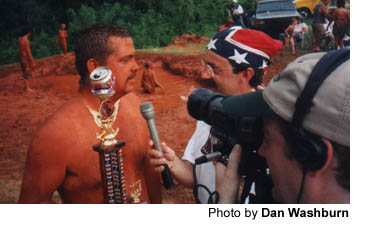
<p>"It's just somebody who likes to get out and have a beer or two in the sun by the river and just have a good time and relax," Blue responded.</p>

<p>"So, are you a redneck?"</p>

<p>"No. No." Blue paused, then added. "But there are plenty of them. Some admit it. Some don't."</p>

<p>Most on hand at Buckeye Park not only admitted it, they celebrated it. They proudly displayed their redneck pride to ... well, all the other rednecks at the games. Confederate flags flew everywhere. Booths sold bumper stickers emblazoned with slogans like, "Never Apologize for Being White." One woman, who had to be close to full-term in her pregnancy, painted "Future Redneck" on her bare belly.</p>

<p>"A redneck is a hard-working person," said Randy ("everybody calls me 'L-Bow the Gin-U-Wine Redneck'") Tidwell. Over the years, the 41-year-old from East Dublin has been adopted as the Redneck Games' official mascot.</p>

<p><img alt="redneck5.jpg" src="http://www.danwashburn.com/mt/sportinglife/archives/redneck5.jpg" width="368" height="227" border="0" align="right" />"A redneck," Tidwell continued, "is someone who don't necessarily get any recognition. They do all the hard work that nobody wants to do. We work hard. We play hard. We die broke."</p>
<p>Tidwell, who drives a wrecker for a living, kicked off the festivities by running in the official Redneck Games torch -- propane, of course -- and lighting the ceremonial barbecue pit. Later, he ran the torch down a hill to signify the start of the evening's fireworks display.</p>

<p>"It's a party atmosphere," Tidwell said. "In a sense, it's like one big family reunion."</p>

<p>Tidwell wore nothing but a pair of overalls and a floppy fishing hat. No shirt. No shoes. He said it was the same outfit he wears every day.</p>

<p>By the middle of the afternoon, Tidwell's neck and shoulders were glowing, some shade beyond red. He was scarlet. Rednecks, he told me, don't believe in sunscreen.</p>

<p><img alt="redneck6.jpg" src="http://www.danwashburn.com/mt/sportinglife/archives/redneck6.jpg" width="269" height="375" border="0" align="right"/>"Too much like lotion," Tidwell said. "Rednecks don't like lotion."</p>
<p>But they like fun and games. And they take the two seriously.</p>

<p>After winning the hubcap toss, 24-year-old Eric Outler of Vidalia, Ga., thanked God and the late Dale Earnhardt for his victory.</p>

<p>"It means a lot to me," Outler said, looking at his trophy topped with a crushed Bud Light can. "It's like winning the Daytona 500."</p>

<p>Without a doubt, the events that attract the most attention are bobbing for pig's feet and the mud-pit belly flop.</p>

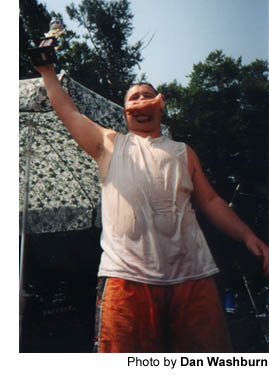
<p>Ashley Richardson, a 19-year-old from Milledgeville, Ga., won the pig's feet competition for the third year in a row. This year, he set a new world record: seven feet in 19 seconds. Afterward, he posed for photos with a pig's foot in his mouth.</p>

<p>"You've got to push them to the bottom, and you've got to grab them," he explained. "You've got to put a good grip on them. It's going so fast, you don't taste them. You don't even have time to taste them."</p>

<p>Back in 1999, MTV sent some of its "Real World" and "Road Rules" participants down to East Dublin for a Redneck Games throw-down. But many of the pseudo-stars threw up instead.</p>

<p>"The kids had to bob for the pig's feet," Blue remembered. "They would bob and get them and then run over in the corner and get sick. But they were a bunch of New York people. Not rednecks."</p>

<p><img alt="redneck8.jpg" src="http://www.danwashburn.com/mt/sportinglife/archives/redneck8.jpg" width="214" height="358" border="0" align="right" />Twenty-six-year-old Ron Johnson of East Dublin won his third straight bellyflop title this year, no doubt due to his home-mud-pit advantage. But by the time the last Budweiser had been drunk that day, nearly everyone had taken a dip in the dirty drink. It was cool in there.</p>

<p>It's not lotion, but a nice thick coating of Georgia red clay blocks those harmful UV rays quite nicely.</p>

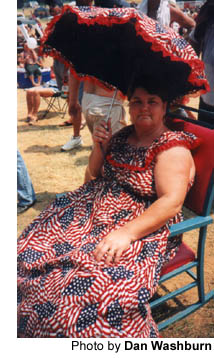
<p>Even the "Redneck Nanny" Barbara Braswyl -- so named because the 47-year-old has (yikes!) 12 grandchildren -- took the plunge, soiling her homemade American flag dress in the process. No worries, Braswyl makes a new dress for every Redneck Games.</p>

<p>"I'm going to do a John Deere one next year," the Wrightsville, Ga., resident said.</p>

<p>First into the mud pit? Who else?</p>

<p>I gave my best Yankee, er, Rebel yell and let my flop fly. When I cleared the mud from my eyes, L-Bow gave me a thumbs-up. I had the official redneck seal of approval.</p>

<p>Five hours later, I was still picking mud from my pockets. </p>]]>
    </content>
  </entry>
  <entry>
    <title>Dawsonville Down Under: Kangaroo court rules NASCAR country</title>
    <link rel="alternate" type="text/html" href="http://www.danwashburn.com/mt/sportinglife/archives/000379.html" />
    <modified>2006-06-14T02:31:38Z</modified>
    <issued>2002-07-04T18:54:36+08:00</issued>
    <id>tag:www.danwashburn.com,2002:/mt/sportinglife/4.379</id>
    <created>2002-07-04T10:54:36Z</created>
    <summary type="text/plain">As a kookaburra cackled in the distance, a wallaby wallowed in the shade of a tall tree. Nearby, a red kangaroo hopped, then stopped. She stared at me quizzically. Her baby joey -- face, feet and tail all peering out of her pouch -- stared, too. Ah, the sights and sounds of ... wait a minute ... Dawsonville? Where were the ear-splitting engines, the checkered flags, the Bill Elliott Coke machines? After all, this is the birthplace of motorsports, not marsupials. Right? Well, just down the road from Thunder Road -- where during prohibition, moonshine runners out-raced police cars and...</summary>
    <author>
      <name>Dan Washburn</name>
      <url>http://www.danwashburn.com</url>
      <email>dan@danwashburn.com</email>
    </author>
    <dc:subject>Offbeat</dc:subject>
    <content type="text/html" mode="escaped" xml:lang="en" xml:base="http://www.danwashburn.com/mt/sportinglife/">
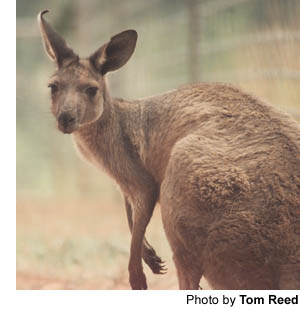
      <![CDATA[<p><a href="http://www.danwashburn.com/mt/sportinglife/archives/kangaroo.html" onclick="window.open('http://www.danwashburn.com/mt/sportinglife/archives/kangaroo.html','popup','width=410,height=434,scrollbars=no,resizable=no,toolbar=no,directories=no,location=no,menubar=no,status=no,left=0,top=0'); return false"><img src="http://www.danwashburn.com/mt/sportinglife/archives/kangaroo-thumb.jpg" width="250" height="264" border="0" align="right" /></a>As a kookaburra cackled in the distance, a wallaby wallowed in the shade of a tall tree. Nearby, a red kangaroo hopped, then stopped. She stared at me quizzically. Her baby joey -- face, feet and tail all peering out of her pouch -- stared, too.</p>

<p>Ah, the sights and sounds of ... wait a minute ... Dawsonville?</p>

<p>Where were the ear-splitting engines, the checkered flags, the Bill Elliott Coke machines? After all, this is the birthplace of motorsports, not marsupials. Right?</p>

<p>Well, just down the road from Thunder Road -- where during prohibition, moonshine runners out-raced police cars and paved the way for the NASCAR drivers of today -- sits the <a href="http://www.kangaroocenter.com/" target="_blank">Kangaroo Conservation Center</a>, an unassuming 87-acre plot that just happens to house the largest collection of kangaroos outside of Australia.</p>]]>
      <![CDATA[<p>No signs lead to the property. An 8-foot bamboo gate opens slowly when visitors buzz themselves in. Entry is granted by reservation only.</p>

<p>The center does very little advertising, and yet its tours are consistently booked. Word-of-mouth and unsolicited media coverage -- of which there has been plenty recently -- have provided the center with all the publicity it needs.</p>

<p><img alt="kangaroo2.jpg" src="http://www.danwashburn.com/mt/sportinglife/archives/kangaroo2.jpg" width="300" height="314" border="0" align="right" />The New York Times, in fact, ran a feature on the center in late May.</p>
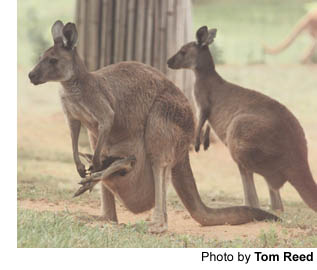
<p>"The phones have been ringing off the hook since then," said soft-spoken Debbie Nelson, who, with husband Roger Nelson, opened the center in 1998. "I think people are just fascinated by kangaroos."</p>

<p>And if it's kangaroos people want, North Georgia, believe it or not, is the place to be.</p>

<p>Sherri Donovan, from Brooklyn, N.Y., read the New York Times piece and booked her family a flight that very night.</p>

<p>"Kangaroos are addicting," Donovan said after an afternoon at the center. "The information you get, and the close-up contact with the kangaroos, I don't think you can get it anywhere else."</p>

<p>Roger Nelson would agree.</p>

<p>"In what we call our outback, you'll see more kangaroos in the next hour than you would see if you took a trip to Australia," he said proudly.</p>

<p>More than 200 kangaroos live at the center, and about 95 percent of them were born there. Other unusual creatures also call the center home. Like the tiny African dik-dik antelope, for example. Extend a finger, and the male will "mark" you with a brown tar-like substance secreted from a large gland underneath his eye.</p>

<p>The Nelsons opened their property to safari-like tours in 2000. Last year, more than 3,000 visitors passed through Dawsonville's version of Down Under.</p>

<p>But the center is far more than just a marsupial amusement park. It is a working zoological breeding facility. Australia rarely allows its native animals to be shipped to foreign countries. The Nelsons have filled that niche.</p>

<p>The center has supplied kangaroos to zoos on four continents, including more than 100 zoos in the United States alone. Sometimes, zoos will send sick kangaroos to the Nelsons, who have shown a knack for nursing them back to health.</p>

<p><img alt="kangaroo3.jpg" src="http://www.danwashburn.com/mt/sportinglife/archives/kangaroo3.jpg" width="317" height="270" border="0" align="right"/>Throw in the tours, and it's quite a bit to tackle. The Nelsons only have four full-time employees.</p>
<p>"It keeps us hopping," Debbie said. She then looked down and smiled. The pun was unintended.</p>

<p>The center seems less a farm and more a family. All the animals there have names. Several kangaroos spent their first months of their lives in the Nelsons' parlor, not a pouch.</p>

<p>"We get very attached to them," Debbie admitted. "It's sort of like raising a baby. They are very affectionate animals."</p>

<p>We were sitting in the Nelsons' office prior to the start of my tour when Roger stood up from his stool and said, "I'll bring in Emily."</p>

<p>Roger returned with what looked to be a plush doll nestled in his arms. Emily is an 8-month-old red kangaroo. Emily weighed less than a pound when her mother died. The Nelsons are her parents now.</p>

<p>Emily shook slightly when Roger brought her closer to me. It was the only way I could tell that she was real.</p>

<p>"They're very shy animals," Roger said. "Their first instinct is to hop away from danger. They're not at all aggressive like some people perceive them to be."</p>

<p>The Nelsons started raising exotic animals 20 years ago when they lived in Alpharetta. They began working with kangaroos four years later, and decided to focus on the animals of Australia when they moved their operation to Dawsonville in 1998.</p>

<p>That's when the media started calling. Soon the Nelsons and their kangaroos were appearing on ABC's "Good Morning America" and "Jack Hanna's Animal Adventures."</p>

<p>It's been quite a ride for the Nelsons. Back in college, Debbie was an art history major. Roger has a degree in engineering.</p>

<p>"That's what keeps life interesting," Roger said. "You never know where you're going to end up."</p>

<p>You know, Roger, you're right. I never thought I'd learn to throw a boomerang in the Bible Belt. Never thought I'd stare a 200-pound kangaroo in the eye there, either. But I did.</p>

<p><img alt="kangaroo4.jpg" src="http://www.danwashburn.com/mt/sportinglife/archives/kangaroo4.jpg" width="300" height="252" border="0" align="right" />The tour begins with the boomerang and moves on to the blue-winged kookaburras. There are only five such birds in North America, we were told. All of them live at the Kangaroo Conservation Center.</p>
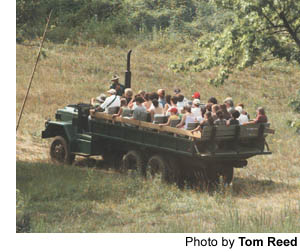
<p>The highlight of the tour is the hour-long trip through the North Georgia "outback." With Springer Mountain -- the southern terminus of the 2,168-mile Appalachian Trail -- looming in the distance, 35 of us squeezed into a converted 1968 Army truck that rumbled through 40 undulating acres.</p>

<p>Kangaroos, mobs of them, were everywhere. There were red kangaroos and gray kangaroos, both the eastern and western variety. Some hopped on by and paid us no mind. But most stopped and stared.</p>

<p>Kangaroos are curious creatures. Always looking, always listening. Their ears move independently. Their eyes are big and black and stare right through you. It's like they're trying to figure you out.</p>

<p>Kangaroos look rather lopsided, really. Their hind legs are huge, with long, floppy feet like clown shoes. Their tales are thick and sturdy. Their front limbs, however, are short and stunted. They dangle downward, as if carrying a small purse.</p>

<p>The largest kangaroo we saw was 7.5 feet from the tip of his tail to the top of his head. He weighed 220 pounds. His name was Red.</p>

<p>He stared at me. And I stared back.</p>

<p>I couldn't figure him out. </p>]]>
    </content>
  </entry>
  <entry>
    <title>Soccer Watching: Late-night confessions of a World Cup junkie</title>
    <link rel="alternate" type="text/html" href="http://www.danwashburn.com/mt/sportinglife/archives/000380.html" />
    <modified>2006-06-14T02:31:38Z</modified>
    <issued>2002-06-27T19:04:09+08:00</issued>
    <id>tag:www.danwashburn.com,2002:/mt/sportinglife/4.380</id>
    <created>2002-06-27T11:04:09Z</created>
    <summary type="text/plain">In a current television commercial, the main character ends up flat on his back in the middle of a crowded sidewalk. He is motionless. Another man takes the guy&apos;s arm and sees that he&apos;s wearing a bracelet, kind of like a medical I.D. tag. He flips it over and finds the image of a soccer ball. &quot;It&apos;s all right,&quot; the man announces to the growing crowd. &quot;He just needs some football.&quot; Lately, I can relate. I&apos;ve been leading a double-life: journalist by day, junkie by night. I&apos;ve been a World Cup fan in America....</summary>
    <author>
      <name>Dan Washburn</name>
      <url>http://www.danwashburn.com</url>
      <email>dan@danwashburn.com</email>
    </author>
    <dc:subject>Ball Sports</dc:subject>
    <content type="text/html" mode="escaped" xml:lang="en" xml:base="http://www.danwashburn.com/mt/sportinglife/">
      <![CDATA[<p>In a current television commercial, the main character ends up flat on his back in the middle of a crowded sidewalk. He is motionless.</p>

<p>Another man takes the guy's arm and sees that he's wearing a bracelet, kind of like a medical I.D. tag. He flips it over and finds the image of a soccer ball.</p>

<p>"It's all right," the man announces to the growing crowd. "He just needs some football."</p>

<p>Lately, I can relate. I've been leading a double-life: journalist by day, junkie by night. I've been a World Cup fan in America.</p>]]>
      <![CDATA[<p>It's been a lonely, nocturnal existence. Japan and South Korea are the tournament hosts this year. And while you are reading this story today, it is probably already tomorrow in Tokyo.</p>

<p>Game times in Georgia have been 2:30 a.m., 5 a.m. and 7:30 a.m. Not exactly prime time.</p>

<p>But I've tried to stay up, or wake up, for many of them. During daylight hours, I walk around like a zombie, my eyes glazed over like soccer balls.</p>

<p>I know there are others out there like me. Friends of mine in New York, and even Atlanta, tell me about late-night and early-morning trips to bars for World Cup watching. Throngs of fans have gathered to watch matches at Major League Soccer stadiums throughout the country. And despite their early-morning starts, the games are drawing a record amount of viewers on television.</p>

<p>But in Gainesville, I often feel like I'm going at this all alone. Bars close before game time. And if they didn't, I doubt crowds would gather for the games, anyway. Gainesville is the Poultry Capital of the World. I'm not sure where the soccer capital is, but I have a feeling it's a long way from here.</p>

<p>Tuesday in South Korea, millions and millions of soccer fans took to the streets to watch their countrymen play. I watch matches in my living room, joined only by a bottle of beer and a box of Golden Grahams. At halftime, I step onto my porch -- and get serenaded by a chorus of crickets.</p>

<p>I thought about turning my house into an after-hours speak-easy for local soccer fans. But I couldn't figure out how to advertise it without getting arrested. Maybe I'll start a self-help group to help those afflicted deal with their World Cup addictions.</p>

<p>There are sure to be some withdrawal symptoms after Sunday morning's championship match between Brazil and Germany.</p>

<p>It's nice to know, though, that there are others who have it worse than me. Franklin McIntosh, director of the Lanier Soccer Association, has not missed a match. That means since May 31, he's seen 62.</p>

<p>"To me, it's something very special," said McIntosh, 38, a former professional soccer player originally from football-friendly West Bromwich, England. "But I'm extremely tired right now. It only happens once every four years, so I like to experience it live."</p>

<p>Often, McIntosh would watch the matches straight through the morning -- from 2:30 a.m. to 9:30 a.m. -- and then head off to work, not to return home again until after 10 p.m. Then it's a quick nap before another night tuned in to ESPN.</p>

<p>"It just depends on how good the middle (5 a.m.) game is," explained McIntosh. "If the middle game is a real good game, I will watch it. If it's not, I will tape it and watch it later on in the evening. I'll watch the 2:30 game, go take a quick nap, and get up for the 7:30 game."</p>

<p>For most matches, McIntosh, like me, watched alone at home. But when England played, he headed down to the Rose & Crown pub in Buckhead.</p>

<p>"They stayed open extra late," McIntosh said. "The atmosphere was just unreal. But it only happened for England."</p>

<p>I have a confession to make. I've been a bad, bad American. Last Friday, I stayed up to watch the quarterfinal match between England and Brazil. After England was eliminated, I went to bed at 4:30 a.m. ... and set my alarm to sound 2Ã‡ hours later.</p>

<p>I needed to be up in time for the U.S.-Germany match at 7:30 a.m. This was a history-making match and there was no way I was going to miss it. The Americans hadn't been in the final eight since 1930. They have never made it to a final four.</p>

<p>Now, one of the perks of my profession is that I rarely have to wake up to an alarm. A sports writer's workday starts late, and ends much later. So sleeping in is not a problem.</p>

<p>Perhaps, then, my lack of practice in clock-programming explains why on Friday I set my alarm for 7 p.m. instead of 7 a.m. Perhaps it explains why I slept through the entire dadgum match.</p>

<p>The U.S. lost 1-0, but that didn't ease my pain. Now I must wait -- at least four more years -- to watch the Americans play in the World Cup again.</p>

<p>Maybe in 2006 I won't feel like such a loner. Maybe this year's U.S. run has brought some more fans into the World Cup fold.</p>

<p>Last Friday, after I finally woke up, I was pleased to find soccer a topic of discussion on the basketball courts at the Family Life Center. That hadn't happened before. It hasn't happened since, either. And likely won't for at least four more years.</p>

<p>But I'm still talking about the World Cup. I was talking about it Tuesday morning after I watched Germany defeat South Korea. I was talking about it Wednesday morning after I watched Brazil take down Turkey.</p>

<p>And now, I know at least one other person whom I can talk about it with. But even McIntosh is growing weary late in this late-night World Cup.</p>

<p>"I still had a good time watching the matches, but it just seemed more of a job to get up and watch the games," McIntosh said. "I am so tired right now, it's unbelievable. I don't want the Cup to end, but at the same time, I'm ready for it to end."</p>

<p>Just two more matches to go, Franklin.</p>

<p>I'll be up for both of them. Right now, though, I need a nap.</p>]]>
    </content>
  </entry>
  <entry>
    <title>Mississippi Handgrabbing (Part Two): Finger food</title>
    <link rel="alternate" type="text/html" href="http://www.danwashburn.com/mt/sportinglife/archives/000382.html" />
    <modified>2006-06-14T02:31:38Z</modified>
    <issued>2002-06-20T19:22:30+08:00</issued>
    <id>tag:www.danwashburn.com,2002:/mt/sportinglife/4.382</id>
    <created>2002-06-20T11:22:30Z</created>
    <summary type="text/plain">Hands are bait when grabbing giant catfish Forget about forethought -- or any other type of thought, really -- when you stick your hand in front of a 40-pound catfish, hoping that the monster mistakes your fingers for food. Thinking can only cause problems. It&apos;s best to do such things with your brain on blank. So, when I first reached my hand into a wooden box occupied by a big, bad blue catfish, the only thing weighing on my mind was the muddy water of the Big Black River -- and the words of Mississippi handgrabber Ricky Liles. &quot;You&apos;ve got...</summary>
    <author>
      <name>Dan Washburn</name>
      <url>http://www.danwashburn.com</url>
      <email>dan@danwashburn.com</email>
    </author>
    <dc:subject>Fishing</dc:subject>
    <content type="text/html" mode="escaped" xml:lang="en" xml:base="http://www.danwashburn.com/mt/sportinglife/">
      <![CDATA[<p><i><b>Hands are bait when grabbing giant catfish</i></b></p>

<p><a href="http://www.danwashburn.com/mt/sportinglife/archives/catfish7.html" onclick="window.open('http://www.danwashburn.com/mt/sportinglife/archives/catfish7.html','popup','width=500,height=414,scrollbars=no,resizable=no,toolbar=no,directories=no,location=no,menubar=no,status=no,left=0,top=0'); return false"><img src="http://www.danwashburn.com/mt/sportinglife/archives/catfish7-thumb.jpg" width="250" height="207" border="0" align="right" /></a>Forget about forethought -- or any other type of thought, really -- when you stick your hand in front of a 40-pound catfish, hoping that the monster mistakes your fingers for food. Thinking can only cause problems. It's best to do such things with your brain on blank.</p>

<p>So, when I first reached my hand into a wooden box occupied by a big, bad blue catfish, the only thing weighing on my mind was the muddy water of the Big Black River -- and the words of Mississippi handgrabber Ricky Liles.</p>

<p>"You've got to get your hand in the fish's mouth," he said. "Because that's the onlyest way you're going to catch him."</p>]]>
      <![CDATA[<p>The folks I met the following day along the banks of the Ross Barnett Reservoir spillway outside of Jackson, Miss., would beg to differ. They were fishing for catfish the regular way, with rods and reels.</p>

<p>I told them about handgrabbing, and that I had tried it. When they were done eyeing me as if I was an escapee from the Mississippi State Insane Asylum, they offered their opinions:</p>

<p>&#149; "Man, I'm not sticking my hand up in nothing in no water," Cortez Green, 33, said. "I don't care if there's tons of fish in there."</p>

<p>&#149; "That's why they made these," said Kevin Primus, 35, pointing to his pole.</p>

<p>&#149; "I know the Big Black. Alligators. Snakes," said Ruth Usry, 56, shaking her head. "There's alligators all in the Big Black. And water moccasins."</p>

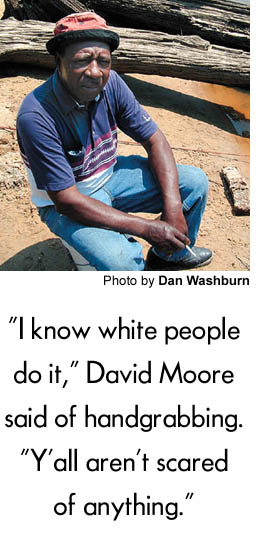
<p><img alt="catfish4.jpg" src="http://www.danwashburn.com/mt/sportinglife/archives/catfish4.jpg" width="273" height="539" border="0" align="right" />&#149; "I know white people do it," David Moore, 63, said. "Y'all aren't scared of anything."</p>
<p>Handgrabbing is not for everybody. It's an activity practiced by men many believe to be either half drunk or half crazy. But it's also an activity that has been around for hundreds of years.</p>

<p>In 1775, trader-historian James Adair first documented "a surprising method of fishing under the edges of rocks" performed by American Indians in the South. Today, the idea is still the same. Handgrabbers have just perfected the process a bit.</p>

<p>Wooden boxes, dozens of them, lie on the bottoms of the Big Black River and Ross Barnett Reservoir. A large number of these custom-made catfish cabins come courtesy of Liles, Keith Lane, Gerald Moore and Mike Willoughby -- the guys from <a href="http://www.mississippihandgrabbing.com/" target="_blank">mississippihandgrabbing.com</a>.</p>

<p>The boxes, often made of durable cypress wood, are the size of coffins. They are placed flat on the river and reservoir floors. An opening, big enough for a giant catfish to fit through, is cut into the end of the box that faces downstream.</p>

<p>During spawning season, male and female catfish seek the shelter of the boxes -- in pairs, of course. Once the female lays the eggs, the male chases her off and guards the eggs viciously until his fingerlings are hatched ... or until some redneck reaches in the box and puts a halt to the whole process.</p>

<p>Many states, in fact, have banned handgrabbing, saying it's not a sporting way to catch fish.</p>

<p>"I think the ones who say that," said Liles, 43, of Canton, Miss., "is the ones, really honestly, who don't have the nerve to do it."</p>

<p>Liles and his crew contend that they raise far more catfish than they catch, saying that they purposefully leave several of their boxes untouched each season.</p>

<p>I asked Ron Garavelli, Mississippi's chief of fisheries, for his thoughts on the matter. He's been on the job for 27 years, and handgrabbing has been legal for all of them.</p>

<p>"Let's just say I don't think the catfish population is hurting because of handgrabbing," said Garavelli, whose response to my next question -- Are you a handgrabber? -- came rather quickly. "No," he said. "I'm not the type of person that puts my hands in places that I can't see."</p>

<p>Not many people are. If any species is at risk of endangerment, Garavelli said, it is the handgrabber.</p>

<p>"It's a dying art," Garavelli said. "I don't think there will be a whole bunch left after this generation. You don't see many young handgrabbers out there."</p>

<p>When 56-year-old Gerald Moore was a "young 'un" in Smith County, Miss., he handgrabbed on the Leaf River.</p>

<p>"Back then, we didn't know about no damn box," Moore said. "We'd find an old cypress log underwater. We done it for the food."</p>

<p><a href="http://www.danwashburn.com/mt/sportinglife/archives/catfish9.html" onclick="window.open('http://www.danwashburn.com/mt/sportinglife/archives/catfish9.html','popup','width=420,height=298,scrollbars=no,resizable=no,toolbar=no,directories=no,location=no,menubar=no,status=no,left=0,top=0'); return false"><img src="http://www.danwashburn.com/mt/sportinglife/archives/catfish9-thumb.jpg" width="250" height="177" border="0" align="right" /></a>And still today, Moore and his cadre of catfish wranglers do it as much for the food as for the fun. But, Moore will tell you emphatically, they "ain't after the damn blue cat."</p>

<p>"We're after the flathead," said Moore, who estimates that each season his group catches more than 3,000 pounds of flatheads, yielding more than 1,000 pounds of meat. "Because, as far as we're concerned, the flathead is the best fish you can put in a frying pan. We don't even keep the blues."</p>

<p>Blue cats are harder to skin, and often even harder to swallow. Unlike the flathead, which prefers its meals to be on the move, blue cats often dine on the dead ... or anything else that floats in front of its mouth.</p>

<p>"Your blue cat has got probably twice stronger jaws than a flathead, kindly like an alligator," Liles said. "When they bite down on something, they can hold that grip."</p>

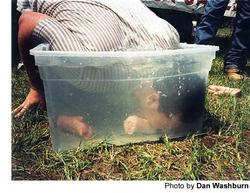
<p>So, when you are submerged in several feet of water and a blue cat swallows your entire hand, you don't have long to meditate on your next move. You'd be surprised how expendable extremities become when your only other option is drowning.</p>

<p>In one such situation, Liles -- who, by the way, can't even swim -- remembers sitting at the bottom of the river, running out of air. His right arm was stuck halfway inside a blue cat in a box.</p>

<p>In desperation, Liles placed his feet on either side of the box's opening, and with one powerful push, forced his hand out of the fish's mouth -- through the vise-like jaw and thousands of tiny teeth. Imagine running your knuckles against a cheese grater.</p>

<p>"You're going to lose some skin," Liles said. "But, hey, you've got to breathe."</p>

<center>&#149; &#149; &#149;</center>

<p>In an early-morning haze three Saturdays ago, we traveled a lonely dirt road through cotton fields and backwoods to a steep and muddy put-in on the banks of the Big Black. We got in our johnboats and journeyed 10 miles upstream. Recent rains made the river rise. A white froth had settled on the surface, making the Big Black look like a giant root beer float.</p>

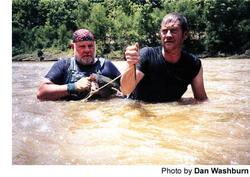
<p><img alt="catfish8.jpg" src="http://www.danwashburn.com/mt/sportinglife/archives/catfish8.jpg" width="300" height="324" border="0" align="right" />Using Lane's mental map as our guide, we made our way back downstream and checked the sunken boxes in our path. The 55-year-old Lane -- handgrabbing for 30 years -- would wade, sometimes neck deep, through the swift water, holding a silver pole like a scepter. When he'd arrive at a box, he'd stick his feet and the pole into the opening.</p>
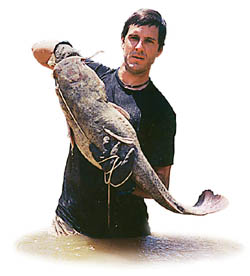
<p>Sometimes the boxes were clean and empty, a sign that the catfish, in Moore's words, had already "done spawned and gone."</p>

<p>If a box is occupied, it's often easy to tell. The catfish go crazy. They make their surroundings shake like a subway car.</p>

<p>"You can hear it underwater," Liles said. "It sounds like thunder."</p>

<p>At that point, the checker becomes the blocker and seals the opening with his feet until the grabber can get his gloves on.</p>

<p>Grabbing can be grueling. It is an often time-consuming task performed primarily underwater. And my companions were already short of breath from smoking cigarettes.</p>

<p>The grabber wedges his arm past the blocker's legs and into the opening. (It's best to stick your arm in up to the shoulder, so the fish trapped inside have no room to make a run for it.) Then, it's a matter of poking around until you find something that feels like a fish head. Often, the fish head finds you.</p>

<p>Ideally, the fish bites down on your fingers and leaves your thumb alone. That way, you can grab on tightly to the cat's lower lip. That's when you've got him. Although, to be honest, it often felt like the fish had me.</p>

<p>It's an odd feeling when a known predator puts its mouth on you. It's a sensation that's hard to put into sentences.</p>

<p>"Well, it's ... it's, uh ... well, I really don't know how to describe it," said Lane, of Waynesboro, Miss. "It's just something biting you."</p>

<p>If it's a small fish -- and in the world of handgrabbing, that means about 30 pounds or less -- the grabber will pull it out of the box and come to the surface with the fish in a headlock.</p>

<p>For the big ones, the ones that would likely fight their way out of a simple wrestling hold, grabbers carry a brass spike attached to a long piece of rope. The spike goes through the fish's lower lip and out its mouth. With the rope looped around the lip and wrapped around the grabber's hand, escape is almost impossible.</p>

<p><img alt="catfish5.jpg" src="http://www.danwashburn.com/mt/sportinglife/archives/catfish5.jpg" width="250" height="276" border="0" align="right" />"This is the golden rule," warned nationally known outdoorsman and novice handgrabber Preston Pittman, who came along on our adventure to film footage for a new outdoors television show. "It's a long walk home, if you let one get away."</p>
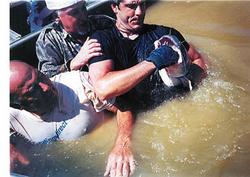
<p>The first nine boxes we checked that morning furnished us with four flatheads, including the 53-pounder Willoughby pulled out on our first stop of the day. Box No. 10, I would soon find out, had my name on it.</p>

<p>"Just stick your arm in there and see if you can feel him," Lane said.</p>

<p>I took the plunge, but the cupboard was bare. Mr. Catfish was holed up in the far end of the box. That's when Lane's pole came into play. A couple pokes, and the catfish had changed its position.</p>

<p>"He's up there now, over my foot," Lane shouted. "He's over my right foot right now."</p>

<p>I went under again and felt the fish's head right away. It was kind of like coming across a ripe melon at the grocery store. At that moment, I was thankful that the water was so muddy. I had no desire to stare into the mouth of whatever was now attached to my arm.</p>

<p>I was in relatively shallow water, so I could bring my head up for air. "I've got it," I gasped.</p>

<p>Liles stuck his hand down to feel the fish. He paused, and then announced to the group gravely, "It's a blue."</p>

<p>Willoughby looked concerned, which didn't help me much: This blue was biting my hand.</p>

<p>"Don't have him string it if it's a blue," Willoughby said. "Just let him come out with it."</p>

<p>I went under again, prepared to do my best Sergeant Slaughter impression and put the damn blue cat in a "death grip" like Moore told me to.</p>

<p><a href="http://www.danwashburn.com/mt/sportinglife/archives/catfish6.html" onclick="window.open('http://www.danwashburn.com/mt/sportinglife/archives/catfish6.html','popup','width=400,height=284,scrollbars=no,resizable=no,toolbar=no,directories=no,location=no,menubar=no,status=no,left=0,top=0'); return false"><img src="http://www.danwashburn.com/mt/sportinglife/archives/catfish6-thumb.jpg" width="250" height="177" border="0" align="right"/></a>"Are you sure it's a blue?" Lane asked Liles. There was so much worry in his voice, I likely would have polluted the river had I not been underwater when he said it.</p>

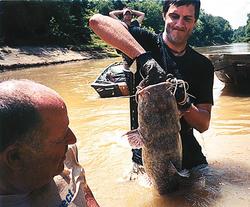
<p>After a short underwater struggle, I shot out of the Big Black with a big blue in tow, my left arm wrapped tight around its repugnant mug.</p>

<p>Soon, I was laughing. And so was everyone else. I was accepted. I was part of the group. My rite of passage weighed 25 pounds and was still trying to eat my right hand.</p>

<p>"My man!" Willoughby exclaimed. "Got him a blue!"</p>

<p>Later on, another box had my name on it. It housed two flatheads, a male and a female who weren't happy that I interrupted their party. The second, and larger one, bit me hard. I uttered some words that Pittman will have to edit out of his TV show.</p>

<p>Near the end of the afternoon, a man yelled to us from the only other boat we passed that day.</p>

<p>"How did y'all do?" he asked.</p>

<p>Moore remained poker-faced. We sat on coolers that contained 14 fish, a catch that weighed close to 350 pounds.</p>

<p>"Just some small ones," Moore said. "Nothing big."</p>

<p>As we drove off, Moore turned to me and cracked a sly smile. With the slime of a 30-pound flathead still glistening on my T-shirt, I smiled back.</p>

<p>I was finally in on the joke.</p>

<p><b>Part One:</b> <a href="http://www.danwashburn.com/mt/sportinglife/archives/000383.html">Man vs. Fish</a></p>]]>
    </content>
  </entry>
  <entry>
    <title>Mississippi Handgrabbing (Part One): Man vs. fish</title>
    <link rel="alternate" type="text/html" href="http://www.danwashburn.com/mt/sportinglife/archives/000383.html" />
    <modified>2006-06-14T02:31:38Z</modified>
    <issued>2002-06-13T19:49:26+08:00</issued>
    <id>tag:www.danwashburn.com,2002:/mt/sportinglife/4.383</id>
    <created>2002-06-13T11:49:26Z</created>
    <summary type="text/plain">Mississippi &apos;masters&apos; lure lunkers ... using only their hands as bait Mike Willoughby emerged from the mud-brown Mississippi water as if he were part of a river baptism, as if the very spirit of the Holy Ghost had taken possession of his being. But Willoughby didn&apos;t come up from the Big Black River singing. He didn&apos;t say, &quot;Hallelujah.&quot; Instead, Willoughby grimaced and grunted. He appeared to be in pain. &quot;He come up and bit me and twisted off,&quot; the 33-year-old paint contractor from Jackson, Miss., said before groaning again. &quot;Felt like a good fish.&quot; Then, Willoughby took a deep breath...</summary>
    <author>
      <name>Dan Washburn</name>
      <url>http://www.danwashburn.com</url>
      <email>dan@danwashburn.com</email>
    </author>
    <dc:subject>Fishing</dc:subject>
    <content type="text/html" mode="escaped" xml:lang="en" xml:base="http://www.danwashburn.com/mt/sportinglife/">
      <![CDATA[<p><i><b>Mississippi 'masters' lure lunkers ... using only their hands as bait</i></b></p>

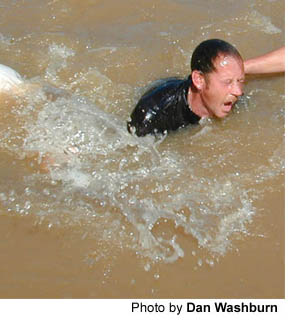
<p><a href="http://www.danwashburn.com/mt/sportinglife/archives/catfishcutout.html" onclick="window.open('http://www.danwashburn.com/mt/sportinglife/archives/catfishcutout.html','popup','width=500,height=484,scrollbars=no,resizable=no,toolbar=no,directories=no,location=no,menubar=no,status=no,left=0,top=0'); return false"><img src="http://www.danwashburn.com/mt/sportinglife/archives/catfishcutout-thumb.jpg" width="250" height="242" border="0" align="right" /></a>Mike Willoughby emerged from the mud-brown Mississippi water as if he were part of a river baptism, as if the very spirit of the Holy Ghost had taken possession of his being.</p>

<p>But Willoughby didn't come up from the Big Black River singing. He didn't say, "Hallelujah."</p>

<p>Instead, Willoughby grimaced and grunted. He appeared to be in pain.</p>

<p>"He come up and bit me and twisted off," the 33-year-old paint contractor from Jackson, Miss., said before groaning again. "Felt like a good fish."</p>

<p>Then, Willoughby took a deep breath and disappeared into the water again. He was trying to coax a giant flathead catfish into biting his hand.</p>]]>
      <![CDATA[<p>After his third dunk into the drink, Willoughby spit water, gasped for air and warned us again that the fish was "a good 'un."</p>

<p>"Alright, I'm fixin' to come out with him," Willoughby announced before going under a final time.</p>

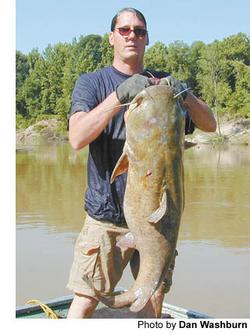
<p>I suppose I shouldn't have reacted with so much shock when Willoughby struggled to the surface with a 53-pound creature in his arms. I mean, I had seen photos and read accounts of men fishing for colossal catfish using only their bare hands. But I always remained skeptical.</p>

<p>Even after Willoughby lugged his leviathan to the boat and placed its still spasmodic body into a cooler, part of me -- the logical and rational part -- questioned the validity of the whole venture. To the uninitiated onlooker, what goes on under the cover of muddy water is a mystery.</p>

<p><a href="http://www.danwashburn.com/mt/sportinglife/archives/catfish.html" onclick="window.open('http://www.danwashburn.com/mt/sportinglife/archives/catfish.html','popup','width=320,height=430,scrollbars=no,resizable=no,toolbar=no,directories=no,location=no,menubar=no,status=no,left=0,top=0'); return false"><img src="http://www.danwashburn.com/mt/sportinglife/archives/catfish-thumb.jpg" width="250" height="335" border="0" align="right" /></a>Perhaps it was a trick, I thought. Willoughby was the magician and the Big Black River was his big black hat.</p>

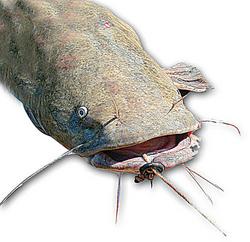
<p>But the monstrosity Willoughby removed from the river was far from cute and cuddly. It was slimy and prehistoric and ugly as sin. It looked like Edward G. Robinson ... hit in the face with a shovel.</p>

<p>I stared, and the fish stared right back. Its wicked-looking whiskers wiggled with each dying breath.</p>

<p>This was most definitely real. And, I realized with mounting misgivings, I soon would be asked to stick my hand in the mouth of one of this catfish's cousins.</p>

<p>For nearly three years, I have tried to pin down a story on the fishy type of fishing known as handgrabbing, noodling, grabbling, grappling, stumping, hogging or dogging, depending on what part of the country you're in.</p>

<p>Two summers ago, a gentleman named Bubba said he'd help set up a handgrabbing trip for me on the Savannah River in eastern Georgia (which, like most states, considers fishing by hand illegal). But Bubba didn't come through.</p>

<p>Last summer, I thought I'd be grabbing in southern Tennessee, but my contact wasn't able to track down the grabbers along the river banks like he thought he'd be able to. And, he said, none of the grabbers had telephones.</p>

<p>I began to suspect handgrabbing was a myth, a colorful part of Southern folklore, the equivalent of snipe hunting -- a well-orchestrated hoax designed to make me look like a fool.</p>

<p><img alt="catfishquote.jpg" src="http://www.danwashburn.com/mt/sportinglife/archives/catfishquote.jpg" width="275" height="432" border="0" align="right" />But that was before a reader e-mailed me the link to <a href="http://www.mississippihandgrabbing.com/" target="_blank">mississippihandgrabbing.com</a>, before I spoke to Gerald Moore on the telephone, before I drove 450 miles just so a giant catfish -- or two, or three -- could bite down on my hand.</p>
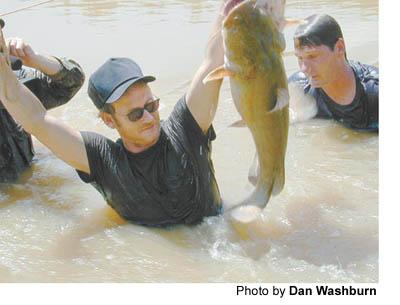
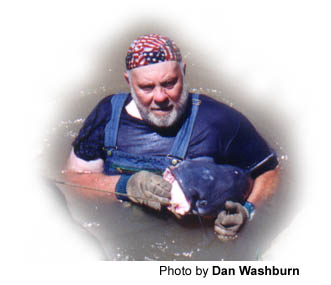
<p>"Oh, it's for real. Trust me," said Moore, 56, known around Jackson as "the master," although he claims the nickname is more for his carpet-cleaning skills than his expertise as a handgrabber.</p>

<p>We were riding in Moore's truck on a back road west of Jackson, towing his johnboat to a remote private put-in along the Big Black, a tributary of the Mississippi River. In the backseat sat Preston Pittman, a world-champion turkey caller from nearby Canton, who was tagging along to videotape footage for an outdoors television show he hopes to launch in 2003.</p>

<p>Moore turned to me and, with the booming bass of a barker for a carnival freak show, said, "What you're going to see today will fascinate you."</p>

<p>Moore, of Madison, owns a carpet cleaning business now, but at various points in his life has been a police officer, a moonshine runner, a Harley-Davidson rider and a country singer. When I met him, he wore faded overalls and a faded blue T-shirt.</p>

<p>The American flag bandana he tied around his head drew attention away from his bright white beard. Moore could easily win an Uncle Jesse Duke lookalike contest, and I wouldn't be surprised if they still have that sort of thing in southern Mississippi.</p>

<p>When Moore showed up at my motel at 5:30 a.m. June 1, he told me he was up late the night before chasing after his three-legged dog. He caught him about a half-mile from the house.</p>

<p>Moore didn't look or act like a man who owned a computer, let alone a Web site. But it's at mississippihandgrabbing.com where you can buy "A Rare Breed ... The Masters of Handgrabbing," the video Moore made with friends Willoughby, Keith Lane and Ricky Liles.</p>

<p><a href="http://www.danwashburn.com/mt/sportinglife/archives/catfish3.html" onclick="window.open('http://www.danwashburn.com/mt/sportinglife/archives/catfish3.html','popup','width=400,height=305,scrollbars=no,resizable=no,toolbar=no,directories=no,location=no,menubar=no,status=no,left=0,top=0'); return false"><img src="http://www.danwashburn.com/mt/sportinglife/archives/catfish3-thumb.jpg" width="400" height="305" border="0" align="right" /></a>Mississippi is the world's leading producer of farm-raised catfish. And Moore believes the state is likely the world's leading producer of handgrabbers, as well.</p>

<p>"Of course you have to bear in mind, we're a bunch of rednecks here," Moore said.</p>

<p>The weekend before I arrived, a crew from CNN came out to go handgrabbing with the self-proclaimed masters.</p>

<p>"We've had all kinds of national attention," Moore said. "We've been on the NBC 'Today Show.' Turner South plays it about near every week. CNN? You can't get no bigger than that."</p>

<p>Folks are just plumb fascinated by handgrabbing which, by my count, is only legal in five states: Mississippi, Alabama, Louisiana, Oklahoma and Tennessee. But I doubt people in the other 46 states really care. Handgrabbing isn't at the top of many to-do lists.</p>

<p>"It takes a special person to go in there and do it," Moore said. "Not that I'm a bad Joe or anything like that, but you've got to have that certain ..."</p>

<p>Moore finished his thought with a powerful grunt that, to me at least, made him sound very much like a bad Joe.</p>

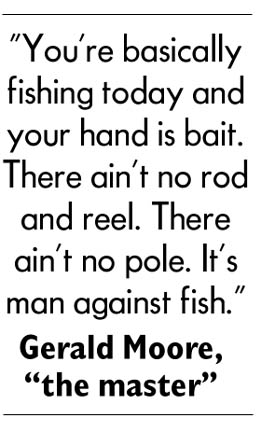
<p>"You're basically fishing today and your hand is bait," Moore continued. "There ain't no rod and reel. There ain't no pole. It's man against fish."</p>

<p><img alt="catfish2.jpg" src="http://www.danwashburn.com/mt/sportinglife/archives/catfish2.jpg" width="331" height="285" border="0" align="right" />Or water moccasin. Or snapping turtle. Or alligator. The Big Black River has them all. But usually, Moore assured me, handgrabbers only run into fish.</p>
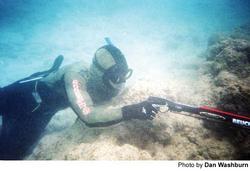
<p>And the fish can be feisty. You would be, too, if someone tried to interrupt your mating season. In Mississippi, it is legal to grab catfish from May 1 to July 15, the weeks when flatheads, and the more ornery blue cats, head to hollowed-out logs -- or, better yet, the cypress boxes placed throughout waterways by handgrabbers -- to spawn, a process that lasts a couple of days.</p>

<p>That's the time when grabbers like to shove their hands in muddy holes most people would never think of. And that's the time when catfish are more than happy to bite, which is ultimately the goal of the grabber.</p>

<p>Moore and his crew wear nylon gloves, the ones used for filleting fish, but they often don't stop the scrapes that leave scars. Catfish have thousands of tiny teeth that can rip off your hide like sandpaper.</p>

<p>"You catch one of them blue cats, and he can tear your (behind) up," Willoughby said. "People think we're crazy as hell."</p>

<p>I dug my foot into the floorboard of Moore's truck as we approached our put-in. I was thinking that those people might be right.</p>

<p><b>Part Two:</b> <a href="http://www.danwashburn.com/mt/sportinglife/archives/000382.html">Finger Food</a></p>]]>
    </content>
  </entry>
  <entry>
    <title>Hawaii Spearfishing: To spear a fish, you must act like one</title>
    <link rel="alternate" type="text/html" href="http://www.danwashburn.com/mt/sportinglife/archives/000385.html" />
    <modified>2006-06-14T02:31:38Z</modified>
    <issued>2002-06-06T15:42:50+08:00</issued>
    <id>tag:www.danwashburn.com,2002:/mt/sportinglife/4.385</id>
    <created>2002-06-06T07:42:50Z</created>
    <summary type="text/plain">He is a predator of the sea, lurking deep beneath the surface, hiding inside cracks in the coral reef, waiting for dinner to swim by. But Wendell Ko does not have gills. He cannot breath underwater. Although, at times it seems like he can. Ko is a Hawaiian spearfisherman. He is also a freediver, which means when Ko plummets 100 feet into the Pacific to hunt a 100-pound fish, he does so with no scuba gear strapped to his back. The only oxygen tanks he travels with are his lungs....</summary>
    <author>
      <name>Dan Washburn</name>
      <url>http://www.danwashburn.com</url>
      <email>dan@danwashburn.com</email>
    </author>
    <dc:subject>Fishing</dc:subject>
    <content type="text/html" mode="escaped" xml:lang="en" xml:base="http://www.danwashburn.com/mt/sportinglife/">
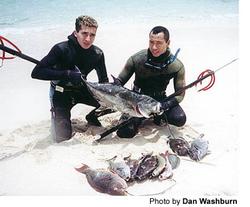
      <![CDATA[<p><a href="http://www.danwashburn.com/mt/sportinglife/archives/spearfish.html" onclick="window.open('http://www.danwashburn.com/mt/sportinglife/archives/spearfish.html','popup','width=500,height=342,scrollbars=no,resizable=no,toolbar=no,directories=no,location=no,menubar=no,status=no,left=0,top=0'); return false"><img src="http://www.danwashburn.com/mt/sportinglife/archives/spearfish-thumb.jpg" width="250" height="171" border="0" align="right"/></a>He is a predator of the sea, lurking deep beneath the surface, hiding inside cracks in the coral reef, waiting for dinner to swim by.</p>

<p>But Wendell Ko does not have gills. He cannot breath underwater. Although, at times it seems like he can.</p>

<p>Ko is a Hawaiian spearfisherman. He is also a freediver, which means when Ko plummets 100 feet into the Pacific to hunt a 100-pound fish, he does so with no scuba gear strapped to his back. The only oxygen tanks he travels with are his lungs.</p>]]>
      <![CDATA[<p>"When you grow up with it, it just becomes natural," said Ko, 41, of Pearl City, a suburb of Honolulu. "If I'm stressed out at home or work, I go in the water for a couple hours of diving. It just totally relaxes you. It's a different world. It's amazing what the ocean can do."</p>

<p>I saw just what the ocean can do May 19. Ko and his 16-year-old son Justin let me tag along as they competed in the Chop Suey Meet, a spearfishing tournament put on by Alii Holo Kai, one of the top freediving clubs in Hawaii.</p>

<p>We met at Haleiwa Beach Park on the North Shore of Oahu at 7 a.m. After the divers were split into teams, the pairs headed off in cars and trucks in search of the piece of the Pacific that would yield the most fish.</p>

<p><a href="http://www.danwashburn.com/mt/sportinglife/archives/spearfish2.html" onclick="window.open('http://www.danwashburn.com/mt/sportinglife/archives/spearfish2.html','popup','width=400,height=332,scrollbars=no,resizable=no,toolbar=no,directories=no,location=no,menubar=no,status=no,left=0,top=0'); return false"><img src="http://www.danwashburn.com/mt/sportinglife/archives/spearfish2-thumb.jpg" width="250" height="207" border="0" align="right"/></a>We were told to be back by 1 p.m. for the weigh-in. The meet works on the honor system. Divers are expected to head into the ocean for their catch, not across the street to the painted sign labeled "Fresh Fish and Fillets."</p>

<p>The Kos and I traveled west and ended up setting off from the sandy shoreline behind a YMCA camp close to the northwestern point of the island.</p>

<p>Wendell Ko knows all the hot spots. He's been spearfishing the islands for 30 years. In middle school, he went without lunch for a month and used his meal money to purchase his first snorkel. His first spear gun was fashioned out of a cue stick.</p>

<p>Ko started spearfishing competitively in the 1980s and in 1999 he captained the Hawaiian team that won the U.S. national championship in Islamorada, Fla.</p>

<p>The fish caught in the Chop Suey Meet were sold in Honolulu the next day. The funds raised will help send this year's Hawaiian spearfishing team to nationals in California.</p>

<p>Ko outfitted me with everything for my maiden voyage. Wetsuit and gloves. Snorkel, mask and fins. He even handed me a spear gun and showed me how to load and reload the shaft. That was a skill that ended up going largely unused.</p>

<p>No use holding a gun if you can't hold your breath.</p>

<p>On our way to the water, we passed a sign that read, "No Swimming: Dangerous Current." I was the only one who seemed to take notice.</p>

<p>Spearfishermen have other worries ... worries with sharp teeth. Ko said that he encounters sharks on every other dive -- they can smell the blood of recently speared fish from miles away.</p>

<p>Every other dive? I asked Ko whether he saw a shark his last time out. He had, but somehow that didn't ease my concern.</p>

<p>"I've never seen the movie 'Jaws.' If I did, that would probably mess me up," Ko said, adding that spear guns can come in handy when a shark is circling.</p>

<p>If a spearfisherman does die in the water, it's usually not due to a shark. A phenomenon called "shallow water blackouts" can strike even the most experienced freedivers.</p>

<p>It often happens less than 15 feet from the surface. Expanding, oxygen-starved lungs literally suck oxygen from the diver's blood. The result is unconsciousness, and typically death.</p>

<p>Ko came close during a competition in 1996. After several deep dives, he stayed under too long, trying to catch a particularly crafty fish.</p>

<p>"I came up and I was all tingly," Ko said. "Everything turned black and white. I didn't know which way was shore and which way was out. I literally had to talk to myself."</p>

<p>We swam roughly 300 yards from shore, through the breaking waves to where the water was slightly less choppy. Because this was a competition designed for novices, we stayed in the shallows. The water was only 20 feet deep.</p>

<p><a href="http://www.danwashburn.com/mt/sportinglife/archives/spearfish3.html" onclick="window.open('http://www.danwashburn.com/mt/sportinglife/archives/spearfish3.html','popup','width=350,height=554,scrollbars=no,resizable=no,toolbar=no,directories=no,location=no,menubar=no,status=no,left=0,top=0'); return false"><img src="http://www.danwashburn.com/mt/sportinglife/archives/spearfish3-thumb.jpg" width="250" height="395" border="0" align="right"/></a>Out there, I could make it to the bottom OK. But by the time I did, my lungs were telling me that it was time to leave. But not Wendell and Justin.</p>

<p>No, they stayed down there and made themselves at home, for minutes at a time. I suppose the best way to catch a fish is to act like one.</p>

<p>Spearfishermen are truly underwater hunters, using coral boulders as cover, tracking their prey. Sometimes divers make grunting noises to call in fish. Most kills happen at close range.</p>

<p>"The guy who knows the fish better, will catch more fish," said 58-year-old Alii Holo Kai member Dennis Okada, noting that many fishing "secrets" are kept within the <i>ohana</i>, or family.</p>

<p>"I feel it's the most selective method of fishing there is. Because you see what you are getting. You are not catching something you don't want to catch. You don't go out and shoot everything in sight."</p>

<p>Ko "selects" most of his fish at 60 feet or below. The deepest he has gone is 130 feet, the mere thought of which makes my eardrums bleed.</p>

<p>The first time you sink to 60 feet, Ko said, all the pressure feels like a simultaneous choke and Heimlich maneuver.</p>

<p>"But as you continue to dive those depths, your body gets used to it," said Ko, who has speared several fish that weighed more than 100 pounds. "So you don't feel the pressure any more. It's amazing what the human body can do."</p>

<p>I shot my spear gun once. And it was not a graceful attempt. It was a sloppy afterthought, a pull of the trigger on my way back up for a breath of air. The target was no fish in particular, just a school way out of range.</p>

<p>The sharp shaft, which is tethered to the rest of the gun, struck some coral and stuck there. At the surface, I tried to hold on, but the gun kept pulling me back under. I eventually had to let go. Justin went back down and got the gun for me.</p>

<p>Still, with two first place finishes, the Ko-Washburn team fared fairly well. We killed 10 fish between us. Wendell had five. Justin had five.</p>

<p>And I speared the rest.</p>

<p><i>Contact Wendell Ko by <a href="mailto:wendell.ko@freedivehawaii.com">e-mail</a> or visit <a href="http://www.freedivehawaii.com" target="_blank">www.freedivehawaii.com</a>.</p>]]>
    </content>
  </entry>
  <entry>
    <title>Antique Tractor Pull: &apos;Good, clean American fun&apos;</title>
    <link rel="alternate" type="text/html" href="http://www.danwashburn.com/mt/sportinglife/archives/000386.html" />
    <modified>2006-06-14T02:31:38Z</modified>
    <issued>2002-05-30T16:03:56+08:00</issued>
    <id>tag:www.danwashburn.com,2002:/mt/sportinglife/4.386</id>
    <created>2002-05-30T08:03:56Z</created>
    <summary type="text/plain">&quot;Turn left at the only red light in town.&quot; When you are given those directions, you know you are headed for a countrified corner of the world. And when you turn onto Holloway Road in Danielsville, you know you have arrived. It&apos;s a graveyard for anything with gears. Tractors, backhoes and school buses -- in varying degrees of disrepair -- line the path that leads to Holloway Hollow, a remote pitch of dirt and grass that houses one of Madison County&apos;s biggest tickets the second Saturday of each month, April through October....</summary>
    <author>
      <name>Dan Washburn</name>
      <url>http://www.danwashburn.com</url>
      <email>dan@danwashburn.com</email>
    </author>
    <dc:subject>Motor Sports</dc:subject>
    <content type="text/html" mode="escaped" xml:lang="en" xml:base="http://www.danwashburn.com/mt/sportinglife/">
      <![CDATA[<p><a href="http://www.danwashburn.com/mt/sportinglife/archives/tractor1.html" onclick="window.open('http://www.danwashburn.com/mt/sportinglife/archives/tractor1.html','popup','width=410,height=376,scrollbars=no,resizable=no,toolbar=no,directories=no,location=no,menubar=no,status=no,left=0,top=0'); return false"><img src="http://www.danwashburn.com/mt/sportinglife/archives/tractor1-thumb.jpg" width="250" height="229" border="0" align="right"/></a>"Turn left at the only red light in town."</p>

<p>When you are given those directions, you know you are headed for a countrified corner of the world. And when you turn onto Holloway Road in Danielsville, you know you have arrived.</p>

<p>It's a graveyard for anything with gears. Tractors, backhoes and school buses -- in varying degrees of disrepair -- line the path that leads to Holloway Hollow, a remote pitch of dirt and grass that houses one of Madison County's biggest tickets the second Saturday of each month, April through October.</p>]]>
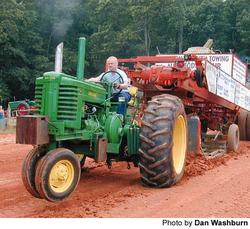
      <![CDATA[<p>It's an antique tractor pull. And it's simple and straightforward. Folks driving old tractors try to pull a weighted sled as far as their engines will allow them.</p>

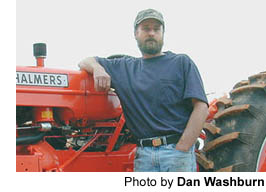
<p>"This is good, clean American fun," said Gainesville resident Tim Akins, 38, who has taken his bright orange 1960 Allis-Chalmers tractor to Holloway for the past two years. "You can bring your wife and your kids. You ain't got to worry about nothing."</p>

<p><img alt="tractor2.jpg" src="http://www.danwashburn.com/mt/sportinglife/archives/tractor2.jpg" width="266" height="192" border="0" align="right"/>Akins paused for a puff on his Hava Tampa Jewel cigar and then added, "I don't think this would be a terrorist target for anyone."</p>
<p>The Stars and Stripes fly proud at Holloway Hollow. The Georgia flag does, too -- and not that newfangled blue one, either. There haven't been many complaints about the Confederate flag's presence at the tractor pull.</p>

<p>If all the hauling makes you hungry, burgers and hot dogs are always on the grill. If you're lucky, there might also be some homemade apple pie and ice cream.</p>

<p>The pulling starts at 5 p.m. sharp. But spectators start arriving long before then. People plop down their lawn chairs to save spots on the grassy slope which has been leveled out into three tiers to accommodate the crowd. Country music is piped through the public address system until the action begins.</p>

<p>"There will be more good ol' boys gathered here than there are left in Hall County," Akins said. Holloway Hollow is one place where the phrase "good ol' boys" is actually taken as a compliment.</p>

<p>Broden Holloway used to farm the land that he turned into a tractor pull strip in 1990. The 69-year-old said, "It was just something I wanted to do."</p>

<p>Holloway, owner of Holloway & Sons Tractor Company in Danielsville, estimates that he lost around $2,500 holding the tractor pulls last year. He doesn't charge admission and only asks $5 per "hitch" from the drivers.</p>

<p>It's not money he's in it for. It's the people.</p>

<p>"Everybody's just good old country folk," Holloway said. "And they're enjoying themselves, it seems like."</p>

<p>On May 11, Holloway wore faded denim overalls and a John Deere cap, two items that appeared to be part of the antique tractor pull uniform. He had a wooden paddle in his back pocket -- an "educational tool" for his grandchildren, he said. The radio headset Holloway wore to communicate with his volunteer staff seemed out of place.</p>

<p>Holloway's tractor pulls haven't changed much over the past 12 years. And he doesn't plan on them changing any time in the near future. Tractors still need to be more than 32 years old to participate. They can only be driven in first gear.</p>

<p>"Most tractor pulls, there's a whole lot of hot-roddin'," Holloway said. "But we don't allow that here."</p>

<p>Some of the antique tractors are so polished and shiny that they might be mistaken for new. Others feature what Akins likes to call their "original finish." It's all rust.</p>

<p>"It's a tractor pull, not a tractor show," clarified Akins, who owns an equipment and truck repair shop in Gainesville.</p>

<p><img alt="tractor3.jpg" src="http://www.danwashburn.com/mt/sportinglife/archives/tractor3.jpg" width="300" height="232" border="0" align="right"/>The pulling action itself is plodding. The tractors never move too fast. No fire shoots out of their exhaust pipes. If people are looking for speed, they can head on over to the go-kart track down the road.</p>
<p>No, the pull is all about power. Sometimes slow and steady does win the race.</p>

<p>"I guess it kind of grows on you," spectator Suzy Seagraves, 25, of Commerce, said. "It's relaxing to me."</p>

<p>The weight on the sled electronically shifts forward during each pull, making progress progressively tougher. Every now and again, the front end of a tractor will rise up off the ground while the rear tires grind deeper into the strip of packed Georgia red clay. And every now and again the fans will clap.</p>

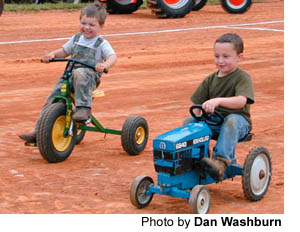
<p>What really brings the crowd to its feet, however, takes place during intermission. It's the kids-only pedal tractor race, a mad dash on dirt to a finish line where everyone receives a trophy. The little tractors move a lot faster than the big ones.</p>

<p>The adults don't pull for trophies or money. They get a plastic plaque if they place in their weight class. But really, these guys pull for pride.</p>

<p>"I come to win every one of them," Akins said. "I don't, but I have that in mind when I come."</p>

<p>The tractor pulls in Danielsville never drag on too long. Everyone is usually packed up and gone by 10 p.m. Plenty of time to sleep and get up for church the next morning.</p>

<p>Broden Holloway wouldn't have it any other way.</p>]]>
    </content>
  </entry>
  <entry>
    <title>Slot Car Racing: &apos;3-2-1, squeeze &apos;em!&apos;</title>
    <link rel="alternate" type="text/html" href="http://www.danwashburn.com/mt/sportinglife/archives/000387.html" />
    <modified>2006-06-14T02:31:38Z</modified>
    <issued>2002-05-16T16:16:33+08:00</issued>
    <id>tag:www.danwashburn.com,2002:/mt/sportinglife/4.387</id>
    <created>2002-05-16T08:16:33Z</created>
    <summary type="text/plain">I inspected the car Mark Taaffe built for me. I had my doubts as to whether it would withstand the beating I was about to put it through. The car was yellow. It had a big blue &quot;0&quot; emblazoned on its roof. &quot;Zero is as close as I could come to a bullseye,&quot; Taaffe said with a smirk. &quot;The new guy always has a bullseye.&quot; And then he placed the car in my hand. It was time for my introduction to the scaled-down world of slot car racing, where the cars are small ... and the thrills are big....</summary>
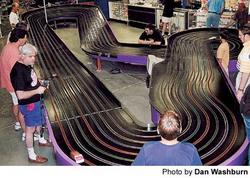
    <author>
      <name>Dan Washburn</name>
      <url>http://www.danwashburn.com</url>
      <email>dan@danwashburn.com</email>
    </author>
    <dc:subject>Motor Sports</dc:subject>
    <content type="text/html" mode="escaped" xml:lang="en" xml:base="http://www.danwashburn.com/mt/sportinglife/">
      <![CDATA[<p><img alt="slotcars2.jpg" src="http://www.danwashburn.com/mt/sportinglife/archives/slotcars2.jpg" width="300" height="244" border="0" align="right"/>I inspected the car Mark Taaffe built for me. I had my doubts as to whether it would withstand the beating I was about to put it through.</p>

<p>The car was yellow. It had a big blue "0" emblazoned on its roof.</p>

<p>"Zero is as close as I could come to a bullseye," Taaffe said with a smirk. "The new guy always has a bullseye."</p>

<p>And then he placed the car in my hand. It was time for my introduction to the scaled-down world of slot car racing, where the cars are small ... and the thrills are big.</p>]]>
      <![CDATA[<p>"It's frustrating at first, there's no doubt about that," warned Taaffe, proprietor of Bullet Raceway, which occupies the back section of the arcade at Bumper's & Bogey's on Jesse Jewell Parkway in Gainesville.</p>

<p>"You can get discouraged. Because it looks so easy."</p>

<p><a href="http://www.danwashburn.com/mt/sportinglife/archives/slotcars1.html" onclick="window.open('http://www.danwashburn.com/mt/sportinglife/archives/slotcars1.html','popup','width=410,height=293,scrollbars=no,resizable=no,toolbar=no,directories=no,location=no,menubar=no,status=no,left=0,top=0'); return false"><img src="http://www.danwashburn.com/mt/sportinglife/archives/slotcars1-thumb.jpg" width="250" height="178" border="0" align="right"/></a>The regulars who race at Bullet Raceway every Friday and Saturday night do make slot car racing seem rather simple. Just press a button and watch your car go.</p>

<p>But there's much more to slot car racing than that. It's the turns that make it tricky. Slot cars, which buzz around the track so fast they become bright-colored blurs, don't always stay in their slots.</p>

<p>I learned that early during my practice session. Take a turn wide open and you're headed into the wall ... or over it.</p>

<p>"You built me a pretty sturdy car," I said to Taaffe, who apparently anticipated the torture I'd inflict on car No. 0. It happens to every beginner.</p>

<p>"It's a tank," Taaffe said with a knowing nod.</p>

<p>We were racing cars 1/24 the size of real cars. For those of you -- like me -- who have no idea how to visualize that ratio, we were racing cars about the size of an adult male hand. A motor is the size of a match box.</p>

<p>Taaffe's road-style track, built in 1964, is full of twists and turns. It's about 100 feet long and eight lanes -- or slots -- wide. Each lane is marked by a different color and has a corresponding control terminal along the straightaway.</p>

<p>Cars are powered electronically. Each "driver" has a controller that hooks into the track and operates a particular lane. Squeeze the trigger, and the car goes. Release it, and the car stands still.</p>

<p>Good racers find a rhythm, somewhere between reckless and reasonable. Great racers run awfully close to reckless, only without all the wrecks. Fast drivers at Bullet Raceway average less than four seconds per lap.</p>

<p>"If you watch the fingers, you can see the finesse," Taaffe said.</p>

<p>Terry Kelly played his controller like it was a musical instrument. His finger squeezed the same song lap after lap. He kept the beat with his head, back and forth, following his car around the track.</p>

<p>Kelly was my coach. And I couldn't have asked for a better one. He's a reigning United Slot Racers Association national champion, a title he won in April at a race in Anderson, S.C. He's also a regular at Bullet Raceway.</p>

<p>"Here, everybody will help you," said Kelly, 48, of Alpharetta. "Until the race starts. And then you're on your own."</p>

<p><img alt="slotcars3.jpg" src="http://www.danwashburn.com/mt/sportinglife/archives/slotcars3.jpg" width="300" height="286" border="0" align="right"/>Luckily, Kelly remained my crew chief even after the green flag dropped.</p>
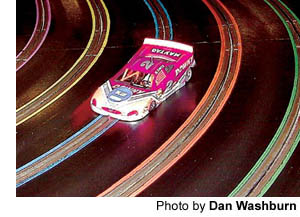
<p>Races are split into eight three-minute periods. Each driver runs one period on each lane. The driver with the most laps after the last period is the winner. A computer does the counting.</p>

<p>Beginner races take a little longer to complete. The clock stops with every crash, and there are several. Thankfully, the "corner marshals" -- the drivers waiting for the next race -- are there to quickly return the careening cars to their proper slots.</p>

<p>Then the public address announcer barks: "3-2-1, squeeze 'em."</p>

<p>The cars and minutes went by so quickly, though, it was rather easy for me to lose track of how many laps I was losing by. Trust me, it was a lot.</p>

<p>After each round, Kelly took my car back to his body shop (he has a large, portable wooden equipment box that travels with him) and made adjustments.</p>

<p>This is serious stuff for Kelly. His story is similar to that of several slot car racers. He got into it as a child, lost interest as a young adult, and rediscovered the hobby in middle age. But slot car racing is more passion than hobby for Kelly these days.</p>

<p>"It's just like any other sport," Kelly said. "I like the competition."</p>

<p>Kelly constructs slot car parts at his home and sells them over the Internet and at Taaffe's store. He has his own racing team (he wore a "Kelly Racing" T-shirt on Friday) and boasts a roster of racers from California, Michigan, Tennessee, South Carolina and Georgia. The Kelly Racing team won five national titles in April.</p>

<p>Kelly said he put nearly 400 hours of work into his car leading up to nationals. He won about $400 for his efforts.</p>

<p><img alt="slotcars4.jpg" src="http://www.danwashburn.com/mt/sportinglife/archives/slotcars4.jpg" width="300" height="217" border="0" align="right"/>"You don't cover your costs," Kelly said. "But you do make some money."</p>
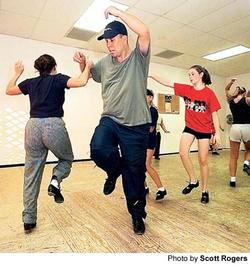
<p>Kelly, who often swaps out tires on his car based on changes in humidity, asked me if the car felt "loose" at one point during my race. I just shrugged.</p>

<p>Of course, Kelly is just an extreme. You can buy a car from Taaffe for as little as $45 and rent a controller for $2. Just like that, you are ready to race.</p>

<p>"We bought cars and just dove right in," said Kevin Umstaedter, 46, of Gainesville, who started slot car racing with his two young sons almost a year ago. "It's a great hobby for kids. And it's a kick in the pants. It's a heck of a lot of fun."</p>

<p>Twelve-year-old Brandon Howorth, a sixth-grader at Chestatee Middle School, has his parents drop him off at Bullet Raceway every Friday night.</p>

<p>"I just like racing," said Howorth, who stumbled upon the hobby six weeks ago and, by the way, soundly defeated the yellow car with a "bullseye" on its roof. "It's fun coming here every Friday to race."</p>

<p>You know Brandon, you're right. Just watch out for the ol' No. 0 car next time. </p>]]>
    </content>
  </entry>
  <entry>
    <title>Clogging: A toe-tappin&apos; good time</title>
    <link rel="alternate" type="text/html" href="http://www.danwashburn.com/mt/sportinglife/archives/000388.html" />
    <modified>2006-06-14T02:31:38Z</modified>
    <issued>2002-04-25T16:26:10+08:00</issued>
    <id>tag:www.danwashburn.com,2002:/mt/sportinglife/4.388</id>
    <created>2002-04-25T08:26:10Z</created>
    <summary type="text/plain">Keith Brady&apos;s feet went off like firecrackers. His knees were loose hinges -- swinging back and forth, up and around. Everything below was a blur. Perhaps Brady was a marionette, I thought. Perhaps someone, or something, was pulling at the strings from up above. He made the unnatural appear natural. He made music with his feet. And then it was my turn. &quot;The good thing about clogging,&quot; said Brady, 35, instructor at the Storm Dancers studio in Oakwood, &quot;there&apos;s no wrong step.&quot; Brady, obviously, hadn&apos;t seen my steps yet....</summary>
    <author>
      <name>Dan Washburn</name>
      <url>http://www.danwashburn.com</url>
      <email>dan@danwashburn.com</email>
    </author>
    <dc:subject>Dance</dc:subject>
    <content type="text/html" mode="escaped" xml:lang="en" xml:base="http://www.danwashburn.com/mt/sportinglife/">
      <![CDATA[<p><a href="http://www.danwashburn.com/mt/sportinglife/archives/clogging1.html" onclick="window.open('http://www.danwashburn.com/mt/sportinglife/archives/clogging1.html','popup','width=410,height=438,scrollbars=no,resizable=no,toolbar=no,directories=no,location=no,menubar=no,status=no,left=0,top=0'); return false"><img src="http://www.danwashburn.com/mt/sportinglife/archives/clogging-thumb.jpg" width="250" height="267" border="0" align="right"/></a>Keith Brady's feet went off like firecrackers. His knees were loose hinges -- swinging back and forth, up and around. Everything below was a blur.</p>

<p>Perhaps Brady was a marionette, I thought. Perhaps someone, or something, was pulling at the strings from up above.</p>

<p>He made the unnatural appear natural. He made music with his feet. And then it was my turn.</p>

<p>"The good thing about clogging," said Brady, 35, instructor at the Storm Dancers studio in Oakwood, "there's no wrong step."</p>

<p>Brady, obviously, hadn't seen my steps yet.</p>]]>
      <![CDATA[<p>Let's get one thing straight. Clogging has nothing to do with wooden shoes or windmills. It's a down-home dance, uniquely American.</p>

<p>But like most things born in Appalachia, clogging's roots reach back across the Atlantic. A little Irish. A little Scottish. Throw in some English. Some German, too.</p>

<p>It was the 1700s, and all the different folk dances fused into one. Unchoreographed. Free-flowing. Much like the lives of the South's early settlers.</p>

<p>"Clogging basically started as buck dancing," Brady explained.</p>

<p>"Buck dancing?" I responded.</p>

<p>"Buck dancing is," Brady began, "you go to a bar and see a bunch of guys that are, um, well lit. It has no structure to it. Just whatever they can stomp out."</p>

<p>Clogging eventually found its way to the flatlands, where it met with other influences, Native American and African-American dance among them.</p>

<p>Clogging continues to evolve today.</p>

<p><img alt="clogging2.jpg" src="http://www.danwashburn.com/mt/sportinglife/archives/clogging2.jpg" width="245" height="304" border="0" align="right"/>"People are making up new steps all the time," Brady said. "They take like half of an Irish step, half of a tap step and half of a Canadian step, put the three together and come up with something totally new."</p>
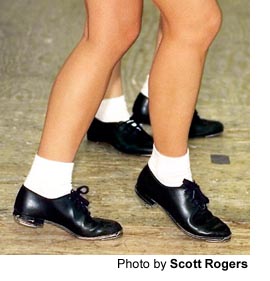
<p>Several years ago, Brady himself helped invent a step during a particularly productive early morning at a bar in Pigeon Forge, Tenn.</p>

<p>It's called a "double-double." It sounds like a musical machine gun. And, I quickly realized, there was no way I was going to come close to accomplishing it.</p>

<p>Clogging draws its name from the Gaelic word for "time." And the clog dancer, wearing shoes very similar to those worn in tap, is supposed to hit the floor on the downbeat.</p>

<p>I was just plain offbeat.</p>

<p>Brady and I were trying to boogie to the Doobie Brothers' "Steamer Lane Breakdown," and I stopped in mid-song. It just didn't feel right.</p>

<p>"That's one good thing about him," Brady said to the growing crowd at the studio (the presence of which likely played a factor in my faulty footwork). "He knows when he's not on beat."</p>

<p>Brady hasn't had that problem in some time. A Hall County native, Brady's family moved to Arcade when he was a young boy. When Brady was 12, he attended a clogging class at the town hall. He hasn't stopped stomping since.</p>

<p>"It was the thing to do," Brady said -- and for anyone who has ever driven through Arcade on the way to Athens, that statement is easy to believe. "It was the only thing you had to do in a little town."</p>

<p>By the mid-1980s, Brady, who performed locally with a group known as the Foot Stompin' Heel Clickers, was the best clogger in the world. Five years straight, he beat out 1,500 competitors to win the "Hee Haw" world championship at the Grand Ole Opry in Nashville, Tenn.</p>

<p>Now he spends his time teaching. At Storm Dancers, he has around 70 students from age 4 to 60. And they clog to anything from bluegrass to country to rock to hip-hop and pop.</p>

<p>"We do routines to all of it," said Brady, a land surveyor when he's not clogging. "When you start clogging to Britney Spears, that's when all the little girls come running saying, 'I want to dance like that.'"</p>

<p><img alt="clogging3.jpg" src="http://www.danwashburn.com/mt/sportinglife/archives/clogging3.jpg" width="270" height="281" border="0" align="right"/>Thirteen-year-old clogger Taylor Soucie, an eighth-grader at West Hall Middle, remembers catching her first glimpse of clogging at the age of 5.</p>
<p>"It was fast," Soucie said. "I thought it was cool."</p>

<p>Kristi Pirkle, 16, who like Soucie is on Brady's performance squad, has been clogging for nearly two-thirds of her life.</p>

<p>"I don't play sports," the West Hall High junior said, "but I thought this was interesting. And it's good exercise."</p>

<p>Brady claims that 15 minutes of clogging is equal to seven miles of running. And if I had been able to last 15 minutes, I'd be able to tell you if he's telling the truth. You'll have to take Brady's word on this one.</p>

<p>I started out strong. I ended up shaky. The more steps Brady taught me, the less I felt I learned.</p>

<p>"I'm thinking too much," I said after realizing I had been sticking out my tongue in contemplation for the lesson's duration.</p>

<p>"Yep," Brady said. "You've got to relax and go with it. You can't think about it a lot."</p>

<p>I watched Brady's top class practice. I watched them relax and release. With the most experienced cloggers, it's as if the beat moves the body, not the other way around.</p>

<p>I liked it best when the music was off and the sound of shoes filled the room like a symphonic factory. Everyone was in step.</p>

<p>The worn wooden floor sagged with each collective stomp.</p>]]>
    </content>
  </entry>
  <entry>
    <title> Garbage Collection: Are you &apos;garbage man material&apos;?</title>
    <link rel="alternate" type="text/html" href="http://www.danwashburn.com/mt/sportinglife/archives/000389.html" />
    <modified>2006-06-14T02:31:38Z</modified>
    <issued>2002-04-21T16:45:52+08:00</issued>
    <id>tag:www.danwashburn.com,2002:/mt/sportinglife/4.389</id>
    <created>2002-04-21T08:45:52Z</created>
    <summary type="text/plain">When Gainesville solid waste superintendent Adrian Niles explained it, the job description seemed simple enough. Get garbage out of can. Put lid back on can. Carry garbage to truck and throw it in the back. Repeat, again and again. So that&apos;s what I did. For one day, I was a Gainesville garbage collector. And, you know, it wasn&apos;t as bad as you might think. Sure, it smelled a bit, and I soiled a pair of slacks. But at the end of the day, I knew my body had been through a day&apos;s work. Real work. Sweat work. We white collar...</summary>
    <author>
      <name>Dan Washburn</name>
      <url>http://www.danwashburn.com</url>
      <email>dan@danwashburn.com</email>
    </author>
    <dc:subject>Offbeat</dc:subject>
    <content type="text/html" mode="escaped" xml:lang="en" xml:base="http://www.danwashburn.com/mt/sportinglife/">
      <![CDATA[<p><a href="http://www.danwashburn.com/mt/sportinglife/archives/trash1.html" onclick="window.open('http://www.danwashburn.com/mt/sportinglife/archives/trash1.html','popup','width=400,height=366,scrollbars=no,resizable=no,toolbar=no,directories=no,location=no,menubar=no,status=no,left=0,top=0'); return false"><img src="http://www.danwashburn.com/mt/sportinglife/archives/trash1-thumb.jpg" width="250" height="228" border="0" align="right"/></a>When Gainesville solid waste superintendent Adrian Niles explained it, the job description seemed simple enough. Get garbage out of can. Put lid back on can. Carry garbage to truck and throw it in the back.</p>

<p>Repeat, again and again.</p>

<p>So that's what I did. For one day, I was a Gainesville garbage collector. And, you know, it wasn't as bad as you might think.</p>

<p>Sure, it smelled a bit, and I soiled a pair of slacks. But at the end of the day, I knew my body had been through a day's work. Real work. Sweat work.</p>

<p>We white collar types tend to forget what that feels like.</p>]]>
      <![CDATA[<p>"It's a good, honest paycheck," 50-year-old Frank Hood, a garbage collector for two decades, said to me as we sat in the lounge of the public works building on Alta Vista Road in the minutes leading up to the 7:30 a.m. start of our work day.</p>

<p>Hood reminded me to wear my gloves -- it's easy to get stuck by syringes or broken glass -- and recommended that I carry along eye protection, too. He closed with a statement that took me by surprise: "It's fun. It really is."</p>

<p>Hood continued, "You meet a lot of different people out there. People who stay in a lot, they miss it all. When you're out there, you know what's going on."</p>

<p>Want to learn a little about your neighborhood? Ask your garbage collectors. You can learn a lot about people by carrying their trash.</p>

<p><img alt="trash2.jpg" src="http://www.danwashburn.com/mt/sportinglife/archives/trash2.jpg" width="270" height="335" border="0" align="right"/>Just judging by the size -- and the smell -- of the load you can determine someone's age, someone's eating habits. Garbage men know when new babies arrive (dirty diapers are a dead giveaway) and when children head off to college (the load becomes a lot lighter).</p>
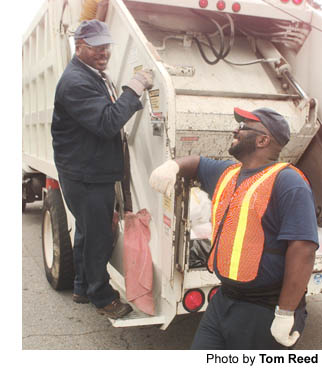
<p>Garbage men know when families move away and when others move in. And they take special notice of any new dogs in the neighborhood. You see, dogs don't differentiate much between the people who pick up the trash and the people who deliver the mail. They don't like either one.</p>

<p>Gainesville is a city that doesn't appear to have been laid out in any particular pattern. Streets criss and cross at odd angles. A single road can be known by several different names.</p>

<p>But it all makes sense in the minds of the garbage men. They drive these streets every day.</p>

<p>It's not just the streets, either. If you live in Gainesville, Richard Trammell, the driver of the truck that I worked on, likely knows where you hide your trash.</p>

<p>"I know where all the hot spots are," Trammell, 45, said with a chuckle.</p>

<p>Gainesville residents aren't asked to bring their trash to the curb. They aren't even asked to bring it to the front of the house. Garbage collectors are expected to collect the garbage from wherever it is kept.</p>

<p>And that could be behind a big tree in the backyard or behind a fence next to the garage.</p>

<p>The level of service shocked Dick Young when he moved to Gainesville from Dekalb County last year. He made a point to say hello to Trammell and my truck's other "toter" Darrell Carter when we pulled up next to his house.</p>

<p>"These guys are great," Young, 67, said. "They are so helpful, too. I never heard them complain, and that's unusual. I wouldn't mind having to bring the trash up myself. I would do it if it came to that. But for them to go around back and pull it out, I think that's terrific."</p>

<p>It's a nice service. I agree. But after eight hours of tramping up driveways and through backyards in search of trash, my aching legs had a different opinion.</p>

<p>The average Gainesville garbage collector -- of whom there are 20, responsible for nearly 5,000 city residences -- walks six miles a day.</p>

<p>"It's just go, go, go," Niles said. "It keeps 20 busy. It's stop and go. It's uphill and downhill. It's hopping off the truck and hopping back on."</p>

<p>Some guys don't even make it through the first day. It's too hard, too smelly, too messy. They radio back to the office and ask to be picked up by the side of the road.</p>

<p>"Even with a garbage toter, it takes a special kind of person that wants to do this work," Niles said. "You would think anybody could do it, but it does take a special kind of person."</p>

<p>Riding on the back of a garbage truck is strangely liberating. Lean back a bit and the wind hits you in your face. It makes you feel like you're flying -- and neutralizes some of the truck's odor.</p>

<p><img alt="trash3.jpg" src="http://www.danwashburn.com/mt/sportinglife/archives/trash3.jpg" width="322" height="375" border="0" align="right"/>I also found pleasure in operating "the blade," the mechanical door that sweeps the trash inside the truck. In a matter of minutes, an overflowing load vanishes. All that is left is a foul soup -- milk, grease, blood and other liquids and juices whose expiration dates have come and gone. The vile brew drips down the blade and settles in a big black puddle.</p>
<p>Oh, and then there's the smell. There's always the smell.</p>

<p>Trammell, Carter and I eventually settled into a rhythm.</p>

<p>"We've got to go get it," said Carter, 34, toting for a little more than a year. "No matter what, rain or snow, we got to go get it. It's our job. That's how we look at it. We work as a team to get this thing done."</p>

<p>When Trammell would stop the truck, I'd look to his face in the side-view mirror. A nod meant it was my turn.</p>

<p>"Go to that white house," Trammell said on one of our early stops. "It's going to be around back. He's got some white bags on his patio."</p>

<p>Sure enough, Trammell was right. And the old man who keeps white bags of trash on his patio was smoking an early-morning cigarette on his screened-in back porch.</p>

<p>"You're a new guy, ain't you?" he said to me.</p>

<p>"Yep," I responded. "It's my first day."</p>

<p>"Well, hang in there. You can retire in about 80 years." The old man laughed.</p>

<p>True, the job of garbage collector is not one people usually plan for themselves. It just kind of happens.</p>

<p>Garbage toters in Gainesville start out at $7.69 an hour. But there's room for advancement. Trammell has been doing it for 21 years, and he's moved from the back of the truck to the driver's seat.</p>

<p>"You would think that out of all the other jobs I had, that they would have been better for me than doing this here," Trammell said. "It's one of the worst jobs in the world, I guess, and I done stuck with it this long. It does have good benefits, though. That's one thing that kept me here this long. And the hours are really good."</p>

<p>We took our only break of the day at mid-morning. By that time, the gloves I wore were no longer white. We sat on the curb at a gas station and ate a snack. The break didn't last long.</p>

<p><img alt="trash4.jpg" src="http://www.danwashburn.com/mt/sportinglife/archives/trash4.jpg" width="268" height="275" border="0" align="right"/>Streets and houses ran together as the day wore on. It all started to look the same to me.</p>
<p>Get garbage out of can. Put lid back on can. Carry garbage to truck and throw it in the back. Repeat, again and again.</p>

<p>Sometimes the monotony is broken. Perhaps you come upon a dead dog covered in maggots -- yep, some people throw those out with the trash -- or an appliance that is still in working condition.</p>

<p>Trammell remembers one time when a homeless man emerged from a Dumpster that was about to be emptied into the truck.</p>

<p>"We almost killed him," Trammell said.</p>

<p>Garbage men are blue-collar magicians. They make things disappear. We often bag up our trash, put it outside and then forget about it. It goes away twice a week. We take it for granted.</p>

<p>"Sometimes a customer will tell me I'm doing a good job," Carter said. "And I take that and say to myself, 'It's going to be all right.'"</p>

<p>I was worried that I might slow Trammell and Carter down, but we made good time. We finished our route and made it back to "the house" with minutes to spare.</p>

<p>"You're garbage man material," Carter said to me with a wide smile. "If you can hang for the day, you're garbage man material."</p>

<p>I took it as a compliment.</p>]]>
    </content>
  </entry>
  <entry>
    <title> Remembering Nell: Someone to watch over me</title>
    <link rel="alternate" type="text/html" href="http://www.danwashburn.com/mt/sportinglife/archives/000390.html" />
    <modified>2006-06-14T02:31:38Z</modified>
    <issued>2002-04-13T16:57:00+08:00</issued>
    <id>tag:www.danwashburn.com,2002:/mt/sportinglife/4.390</id>
    <created>2002-04-13T08:57:00Z</created>
    <summary type="text/plain">My dear old next door neighbor, Nell Thompson, passed away Sunday. And I didn&apos;t even realize it until Wednesday afternoon. I&apos;ve spent the long hours since trying to figure out how that could happen. I learned of the sad news while reading the newspaper. I saw Nell&apos;s name and face on the obituary page and threw down the paper in disbelief. Then I read further, and I threw down the paper in disgust. I had missed Nell&apos;s funeral. I had been playing basketball instead. I felt awful. I felt guilty. So I started to write. That&apos;s all I knew to...</summary>
    <author>
      <name>Dan Washburn</name>
      <url>http://www.danwashburn.com</url>
      <email>dan@danwashburn.com</email>
    </author>
    <dc:subject>Other</dc:subject>
    <content type="text/html" mode="escaped" xml:lang="en" xml:base="http://www.danwashburn.com/mt/sportinglife/">
      <![CDATA[<p><img alt="nell.jpg" src="http://www.danwashburn.com/mt/sportinglife/archives/nell.jpg" width="137" height="206" border="0" align="right"/>My dear old next door neighbor, Nell Thompson, passed away Sunday. And I didn't even realize it until Wednesday afternoon. I've spent the long hours since trying to figure out how that could happen.</p>

<p>I learned of the sad news while reading the newspaper. I saw Nell's name and face on the obituary page and threw down the paper in disbelief. Then I read further, and I threw down the paper in disgust.</p>

<p>I had missed Nell's funeral. I had been playing basketball instead.</p>

<p>I felt awful. I felt guilty. So I started to write. That's all I knew to do.</p>]]>
      <![CDATA[<p>Nell and I didn't have much in common when I moved here in the fall of 1998. She was in her 80s, a lifelong resident of Hall County. I was in my mid-20s, a transplant from up north.</p>

<p>But we were neighbors. And in certain parts of the country, that still means something.</p>

<p>It's clear to me now that the neighborly relationship Nell and I shared was an important part of my existence here in Gainesville. It was a constant I could always count on. But I don't think I ever expressed the importance of our friendship to Nell.</p>

<p>Nell, who was 84 when she died following a sudden illness, lived alone in a home on Hillcrest Avenue just a few feet from mine, but our paths didn't cross as often you might think. Journalists and senior citizens don't keep the same hours.</p>

<p>When we did see each other, we'd always stop to chat.</p>

<p>I'd emerge from my house at midday to retrieve the newspaper from my steps and Nell would be raking leaves or pulling weeds -- she loved working in her yard, as much as her aged body would allow. Sometimes we'd go to our mailboxes at the same time.</p>

<p>Nell would always wave me over. Nell always wanted to talk.</p>

<p>"How's your mom and them?" she would ask.</p>

<p>We talked about the weather a lot. Nell was always worried that a bad storm was going to knock a tall tree through the roof of her tiny home.</p>

<p>On the surface, our conversations never had much substance. Nell just seemed happy to talk about anything.</p>

<p>Nell said she felt safe with me living next door. And she kept a watchful eye over me, as well. She noticed when my car was gone for long periods of time, and would always call me upon my return.</p>

<p>She'd never leave a message, though. Nell didn't care for answering machines.</p>

<p>Nell liked that I wrote for the newspaper. I interviewed her for a story I did during the ice storm in February 2000. Our street was without power for the better part of a week, and I found Nell wrapped in blankets in front of her gas-powered fireplace sipping coffee she had heated campfire-style in the flames.</p>

<p>The story appeared on the front page. Nell said I made her a celebrity over at the senior center.</p>

<p>Nell seemed to take comfort in the fact that she could see her neighbor's photograph in the paper each week, even if sometimes she couldn't remember what day my Sporting Life column appeared in The Times.</p>

<p>"I haven't seen your picture in the paper the last couple Mondays," Nell said to me last year.</p>

<p>"Nell, my column runs on Tuesdays," I replied.</p>

<p>Nell thought about it. "Always has?"</p>

<p>"Yes."</p>

<p>"Now you're not going to tell me I'm getting old, are you?" she said with a laugh and a pat on my arm.</p>

<p>Yes, Nell was getting old. She liked to remind me of her age and her assorted maladies. But she was very proud that she lived on her own, that she still worked in her yard, that she still drove herself to church and the grocery store.</p>

<p>Every day, Nell walked up and down our street. Doctor's orders.</p>

<p>I saw Nell walking last week. A surgical mask covered her face. I waved from my car. I'm pretty sure she saw me. I'm pretty sure that was the last time I saw her.</p>

<p>Nell rarely asked for help with anything. But when she did, I was happy to do what I could.</p>

<p>I remember last December, she asked me to carry her porcelain Christmas tree from her basement to her living room. She had made the tree several years ago and didn't trust herself with it.</p>

<p>Even for a small gesture like that, Nell was most appreciative. Now, I am left thinking I could have done much more for Nell while she was here.</p>

<p>But Nell was always thankful for anything. She'd often tell me she didn't know what she would do if I ever moved away. Now, I wonder what I am to do now that she is gone.</p>

<p>Nell's car is still parked in front of her house. Her rake is still propped up against the side wall.</p>

<p>I walked outside to fetch my mail Thursday and glanced toward Nell's house. Part of me expected her to emerge from her front door, too.</p>

<p>I waited. But it never happened.</p>]]>
    </content>
  </entry>
  <entry>
    <title> Team Penning: Not just horsing around</title>
    <link rel="alternate" type="text/html" href="http://www.danwashburn.com/mt/sportinglife/archives/000391.html" />
    <modified>2006-06-14T02:31:38Z</modified>
    <issued>2002-04-11T17:10:01+08:00</issued>
    <id>tag:www.danwashburn.com,2002:/mt/sportinglife/4.391</id>
    <created>2002-04-11T09:10:01Z</created>
    <summary type="text/plain">John Hulsey remembers riding his horse down Green Street. He&apos;d clip-clop on over to the old Royal Theater, which used to occupy the vacant lot next to Clore&apos;s Restaurant. He&apos;d tie up his horse and take in a movie. This was the 1960s -- not too long ago, really. Back then, Gainesville was more Wild West and less Atlanta. Back then, Gainesville was horse country. And now, Hulsey sees the area experiencing a rebirth in all things equine. &quot;It&apos;s really mushrooming again,&quot; Hulsey, 49, of Gainesville, said. &quot;It kind of brings people back to older days.&quot; The sport that brought...</summary>
    <author>
      <name>Dan Washburn</name>
      <url>http://www.danwashburn.com</url>
      <email>dan@danwashburn.com</email>
    </author>
    <dc:subject>Horse Sports</dc:subject>
    <content type="text/html" mode="escaped" xml:lang="en" xml:base="http://www.danwashburn.com/mt/sportinglife/">
      <![CDATA[<p><a href="http://www.danwashburn.com/mt/sportinglife/archives/penning.html" onclick="window.open('http://www.danwashburn.com/mt/sportinglife/archives/penning.html','popup','width=410,height=340,scrollbars=no,resizable=no,toolbar=no,directories=no,location=no,menubar=no,status=no,left=0,top=0'); return false"><img src="http://www.danwashburn.com/mt/sportinglife/archives/penning-thumb.jpg" width="250" height="207" border="0" align="right"/></a>John Hulsey remembers riding his horse down Green Street. He'd clip-clop on over to the old Royal Theater, which used to occupy the vacant lot next to Clore's Restaurant. He'd tie up his horse and take in a movie.</p>

<p>This was the 1960s -- not too long ago, really. Back then, Gainesville was more Wild West and less Atlanta. Back then, Gainesville was horse country.</p>

<p>And now, Hulsey sees the area experiencing a rebirth in all things equine.</p>

<p>"It's really mushrooming again," Hulsey, 49, of Gainesville, said. "It kind of brings people back to older days."</p>

<p>The sport that brought Hulsey back to horses is team penning. He picked it up a little more than a year ago, and now he can't get enough.</p>]]>
      <![CDATA[<p>Team penning is similar in several ways to the horse sport of cutting. But penning is pushy. It's more offense than defense.</p>

<p>And in penning, the cowboys -- and cowgirls -- make a heck of a lot more noise.</p>

<p>Here are the basics: A herd of 30 cattle, numbered "0" through "9" three times over, settles at one end of an arena. As a team of three people on horseback approaches the herd, the public address announcer calls out one of the numbers.</p>

<p>The three cattle wearing that number become the targets. The riders must separate them from the herd and get them into a small pen at the far end of the arena in less than 90 seconds. The fastest time wins.</p>

<p>"I've had just about every hobby there was in the history of the world," Hulsey said. "And I've had more fun doing this than anything I've ever done. It's a rush. It's wide open. It's fast."</p>

<p>Well, it's supposed to be fast. But two weeks ago, during my first penning lesson at Hulsey's farm in White County, I was more slowpoke than cowpoke.</p>

<p>"You're not from around here, are you?" asked Hulsey's penning pal Devin White. The 20-year-old Gainesville High graduate, a horseshoer by trade, insisted he was referring to my accent and not my riding style. That, he tried to blame on the horses.</p>

<p>Hobo. Leo. Rusty. I rode them all that morning. Sometimes, the horses wouldn't go the direction I thought I was directing them. Other times, they wouldn't go much at all. Hulsey remarked that he had never seen Rusty so reluctant to run.</p>

<p>I knew what the problem was. And I'm fairly certain Hulsey and White knew it, too -- they were just too nice to say it. The problem was the rider, not the ridee. But they still kept swapping out horses on me anyway.</p>

<p>No matter. Any horse can sense when a rider is tense.</p>

<p>And I had good reason to be. Penning is not intended for the novice rider. It involves sudden starts and stops and flat-out sprints. Even the most experienced riders can end up in a heap on the ground. That is part of the draw.</p>

<p>So are belt buckles.</p>

<p>Hulsey and White -- along with a few other local residents, including Hulsey's stepdaughter Crista Ragsdale -- are regulars at the weekly team penning jackpot contests at Mike "Curly" PhillipsÃƒÂ¢ Cherokee Rose Arena in Carnesville.</p>

<p>It's the only show for miles. Every Saturday, penners from across the Southeast -- Florida, Tennessee, Alabama, South Carolina, North Carolina and, of course, Georgia -- come to ride at Curly's.</p>

<p><img alt="penning2.jpg" src="http://www.danwashburn.com/mt/sportinglife/archives/penning2.jpg" width="300" height="217" border="0" align="right"/>"Curly's is a place the pros come to practice," White said. "It's people that run the circuit. This is where you're going to get to ride with the best around here in the Southeast. They all go to Curly's."</p>
<p>"We just want to win," Hulsey added. "We're paying $10,000 to win a $175 belt buckle."</p>

<p>"But you won it," White said with a satisfied smile. "You didn't buy it."</p>

<p>The "Spring Fling" belt buckle series at Curly's is currently at its halfway point, and Hulsey and White are both running in the top-10 in the points standings.</p>

<p>I went and watched them a couple of weeks ago. I got there at about 6 p.m. and left at 11 p.m. The riders kept riding for several hours after that. There is money at stake, but not much. Each event pays out 60 percent to the winners. Entry fees max out at $15.</p>

<p>"They just love it," said Curly, who plays the role of announcer, herder, plowman and janitor for these rodeos he's been running for the past dozen years. "It's probably the most fun you can have with your clothes on."</p>

<p>It's not too bad for the spectators, either. At Curly's, the cattle are always "fresh" -- meaning frisky -- and successful runs are the exception rather than the rule.</p>

<p>You see, the riders have more than just the 90-second limit to deal with. There is a "foul line," too, typically the halfway point of the arena. Teams are disqualified if they let cattle of the wrong number break from the herd and cross the foul line. Same result if cattle chased toward the pen somehow sneak their way back across the foul line.</p>

<p>That makes for some desperate dashes ... and savage screams.</p>

<p>"Hey! Hey! Hey! Get back there, you darn cow!" the rider yells, body angled sharply forward, hands steering horse like a stock car.</p>

<p>It was chilly that night at Curly's. Steam rose from the heads of hot horses. But some hot cocoa and a quesadilla from Judy Brown's kitchen hit the spot. And riders know, cold doesn't last long in Georgia.</p>

<p>"In the summer, God it's dusty," Hulsey said as he waited for his next run. "It's hot and you'll be out here until 2 o'clock in the morning. And then you've got to drive all the way back. And then you've got to get up and go to church.</p>

<p>"It's rough. But it's fun."</p>

<p>And you can always use a new belt buckle, right?</p>

<p><i><b>Cherokee Rose Arena</b></i></p>

<p><b>Where:</b> Carnesville</p>

<p><b>When:</b> 6 p.m. Saturday</p>

<p><b>What:</b> Year-round competition in team penning, sorting and one-on-one.</p>

<p><b>Entry fees:</b> Range from $5-$15. Events pay out 60 percent to winners.</p>

<p><b>Contact:</b> Mike "Curly" Phillips, (706) 335-7481</p>

<p><b>Directions:</b> From Gainesville, take U.S. 129 south to I-85 north. Proceed 17 miles on I-85 to the Ga. 63/Martin Bridge Road exit, number 154. Turn right onto Martin Bridge for .2 miles and turn left onto Ga. 59. Travel 2.3 miles and turn right onto Bold Springs Road. After 5 miles, turn left onto an unnamed gravel road marked by a small "Cherokee Rose Arena" sign. Bear right at fork in road. Arena is on left.</p>]]>
    </content>
  </entry>
  <entry>
    <title> Zamboni Drivers: The ice men cometh</title>
    <link rel="alternate" type="text/html" href="http://www.danwashburn.com/mt/sportinglife/archives/000392.html" />
    <modified>2006-06-14T02:31:38Z</modified>
    <issued>2002-04-04T17:24:22+08:00</issued>
    <id>tag:www.danwashburn.com,2002:/mt/sportinglife/4.392</id>
    <created>2002-04-04T09:24:22Z</created>
    <summary type="text/plain">It is a movable throne. In it sits the king of the common man. He is the Zamboni driver. The Atlanta Thrashers won only 19 of their first 76 games this season. That&apos;s the worst record in the National Hockey League. But the Zamboni drivers at Philips Arena can do no wrong. They are cheered every time they take the ice. Perhaps this happens because Thrashers fans, like the followers of any franchise in its infancy, are in desperate need of something to get excited about. Or perhaps Americans just love anything with four wheels and a motor....</summary>
    <author>
      <name>Dan Washburn</name>
      <url>http://www.danwashburn.com</url>
      <email>dan@danwashburn.com</email>
    </author>
    <dc:subject>Offbeat</dc:subject>
    <content type="text/html" mode="escaped" xml:lang="en" xml:base="http://www.danwashburn.com/mt/sportinglife/">
      <![CDATA[<p><a href="http://www.danwashburn.com/mt/sportinglife/archives/zamboni.html" onclick="window.open('http://www.danwashburn.com/mt/sportinglife/archives/zamboni.html','popup','width=410,height=346,scrollbars=no,resizable=no,toolbar=no,directories=no,location=no,menubar=no,status=no,left=0,top=0'); return false"><img src="http://www.danwashburn.com/mt/sportinglife/archives/zamboni-thumb.jpg" width="250" height="210" border="0" align="right"/></a>It is a movable throne. In it sits the king of the common man. He is the Zamboni driver.</p>

<p>The Atlanta Thrashers won only 19 of their first 76 games this season. That's the worst record in the National Hockey League.</p>

<p>But the Zamboni drivers at Philips Arena can do no wrong. They are cheered every time they take the ice.</p>

<p>Perhaps this happens because Thrashers fans, like the followers of any franchise in its infancy, are in desperate need of something to get excited about. Or perhaps Americans just love anything with four wheels and a motor.</p>]]>
      <![CDATA[<p>Either way, Matthew Krull isn't complaining.</p>

<p>"I'm the kind of person, I need my 15 minutes of fame every once in a while," said Krull, 28, of Crabapple, who has been one of the main Zamboni drivers at Philips since the Thrashers got their start in 1999. "I really get a thrill out of it."</p>

<p>He's not the only one. During Thrashers games at Philips, a lucky fan gets to ride shotgun for every Zamboni run around the rink. They wave to the crowd, pump their fists and give the Zamboni driver high-fives.</p>

<p><img alt="zamboni2.jpg" src="http://www.danwashburn.com/mt/sportinglife/archives/zamboni2.jpg" width="320" height="400" border="0" align="right"/>"Everybody wants a ride," said 28-year-old Javits Britt, who hitchhiked to Atlanta from Ann Arbor, Mich., three years ago to become a Zamboni driver for the Thrashers. "Or they want tickets. Or they want a puck."</p>
<p>But mostly people ask about the Zamboni ... or whatever they choose to call it.</p>

<p>"So many of them butcher the name," said Chuck Robinson, 43, of Jefferson, known officially around Philips as the assistant director of building operations. Unofficially, people call him "the ice guy."</p>

<p>Stromboli. Zucchini. Cambodia. Robinson has heard people mangle the word Zamboni several ways in his 23 years working at ice rinks.</p>

<p>Whatever word they use, people seem mesmerized by the two massive machines that make rough ice glassy again between periods at a Thrashers game.</p>

<p>"We kind of feel like we're putting on our own little show out there," Robinson said.</p>

<p>But the performance is not without purpose.</p>

<p>"Fans don't really understand how important the ice is," Thrashers defenseman Brian Pothier said. "They just think that we go out there and ice is ice. But if you have a crew that takes care of the ice well, it's really important to the team.</p>

<p>"Here, it's great, especially for the southern climate. You would think that the humidity and the hot weather would kind of mess it up. But here, it's just as good as any sheet of ice up north."</p>

<p>Robinson is an Atlanta native who has spent most of his adult life making ice, a warm-weather guy who spends most of his days in the freezing cold. He manages an ice crew of 10, mostly part-timers. They include Zamboni drivers, snow shovelers and the people who make sure the holes that hold the goals don't freeze over.</p>

<p>"Yeah, it's a novel job," Robinson said. "Certainly nobody else in the city does it. Not too many people in the state do it."</p>

<p>Robinson paid his dues in community rinks in Atlanta, Orlando, Cincinnati and Pittsburgh before landing his current gig, ice guru for his hometown hockey club.</p>

<p>"You can't go much higher than this, really," Robinson said. "Maybe if you were the Zamboni driver for the Toronto Maple Leafs, that might be a little more prestigious."</p>

<p>The NHL prefers the term "ice technician," because ice guys do much more than drive a Zamboni, especially on game days.</p>

<p><img alt="zamboni3.jpg" src="http://www.danwashburn.com/mt/sportinglife/archives/zamboni3.jpg" width="300" height="256" border="0" align="right"/>"It's an all-day job," Robinson said. "It's a 16-hour investment from start to finish."</p>

<p>March 27, I tagged along with Robinson and his crew as they prepared Philips for the Thrashers' 7:30 p.m. game against the Minnesota Wild. When I arrived at 4 p.m., Krull had already been on the job for nine hours.</p>

<p>The ice was filthy when he got there. It had been covered up for nine days. Philips is a multipurpose arena. In addition to the Thrashers, it's home to the National Basketball Association's Atlanta Hawks, Arena Football's Georgia Force and several major music concerts.</p>

<p>Underneath it all, the ice remains. It's only cover, some pieces of plywood.</p>

<p>So step one is scraping the ice surface free of everything that shouldn't be there -- gum, beer and half-eaten hot dogs included.</p>

<p>Sometimes just scraping doesn't cut it. Robinson recalled a time when members of the rap-metal group Limp Bizkit spilled an entire bottle of something alcoholic that seeped deep within the hockey floor. A circular saw had to be used to remove the stained section of ice.</p>

<p>The ice, actually, is less than an inch thick for Thrashers games. The floor design is painted on top of two thin layers of ice and then encapsulated by more layers of ice, including the playing surface.</p>

<p>After clearing the floor of debris, Krull spent the rest of the morning rebuilding the ice with the Zamboni, which, by the way, got its name from the man who invented it. Frank Zamboni made his first self-propelled ice resurfacer in 1949. Prior to that, ice rinks relied on carts pulled by horses or tractors -- and a lot of guys with shovels.</p>

<p>The Zamboni is much more than just an ice polisher. It shaves the ice and picks up the snow. It washes the ice and smoothes the surface. Then it spreads a layer of clean hot water -- more than 160 degrees hot -- over the ice.</p>

<p>The hotter the water, the clearer it freezes. And in about four minutes, about the amount of time the Zambonis are allotted between periods, the ice is hard enough to skate upon. That's because of the concrete slab underneath, which features nine miles of pipes filled with chemicals that are constantly cooled to 17 degrees.</p>

<p>That makes for some cold working conditions. You feel it first in your feet (Robinson wears thermal socks to work), and then it spreads. It stays with you, too.</p>

<p>"You wake up and your bones are just cracking," Krull said.</p>

<p>But cold is part of the job description when you're working with frozen water. Robinson said his crew has a "passion for ice." And that usually starts with a passion for hockey.</p>

<p><a href="http://www.danwashburn.com/mt/sportinglife/archives/zambonidan.html" onclick="window.open('http://www.danwashburn.com/mt/sportinglife/archives/zambonidan.html','popup','width=410,height=380,scrollbars=no,resizable=no,toolbar=no,directories=no,location=no,menubar=no,status=no,left=0,top=0'); return false"><img src="http://www.danwashburn.com/mt/sportinglife/archives/zambonidan-thumb.jpg" width="250" height="231" border="0" align="right"/></a>"It makes me feel more a part of the sport," said Britt, whose favorite perk is his permanent front-row seat for the games. "If you're a hockey fan, it doesn't get any better than this."</p>

<p>The goal of the Zamboni driver is to create the perfect sheet of ice, smooth and safe, every time. When dealing with a liquid and ever-changing atmospheric conditions, even indoors, that's easier said than done.</p>

<p>"The reality of it is, ice is a tough situation to make perfect," Robinson said. "If they would give us 15 or 20 minutes, we could get awful close. But who wants to sit through 15 or 20 minutes of Zamboni driving?"</p>

<p>Robinson might be surprised.</p>

<p>"The Zamboni is the best part," said 13-year-old Thrashers fan Alex Shilling, of Alpharetta. "It's cool how they're so synchronized."</p>

<p>It can be rather hypnotizing, I found. I watched the Zamboni work from several vantage points last week -- the passenger seat, the front row, the upper deck -- and I found pleasure in each one.</p>

<p>With each pass, rough becomes smooth, old becomes new. The Zamboni has a way of erasing the past. And in the Thrashers' 4-2 loss to the Wild, there was plenty worth forgetting.</p>

<p>Seated in the press box, up near the roof, I watched the arena lights reflect in the Zamboni's shiny wake before the second period began. And then I watched players come out and scratch it all up again.</p>

<p>That's the part that makes Robinson smile.</p>

<p>"It's great," he said. "That's what it's there for."</p>]]>
    </content>
  </entry>

</feed>